Opening the post0.0s

11 min read
Before answering this in depth, please think about the following question:
What part of the agent loop is your hardware supposed to accelerate?
(If you need a TL;DR, you can scroll to the bottom.)
A chat UI and an agentic system stress hardware differently.
An agentic coding system cares about repeated long-context reads, tool calls, cache churn, parallel background workers, retrieval, subprocesses, test runs, container work, and sometimes many independent agents trying to use the same model server at once.
Rather than comparing "Mac versus NVIDIA" or "unified memory versus VRAM", you should focus on the workload decomposition problem.
Before we start the hardware discussion, please do not buy hardware by comparing one headline tokens-per-second number.
Map your agent workflow to four bottlenecks:
Once you do that, the debate gets much less emotional and much more useful.
The most useful part of the recent M5 vs DGX Spark vs Strix Halo vs RTX PRO 6000 discussion is the benchmark design.
The MMBT fleet study did something many hardware comparisons skip: it tried to hold model bytes and engine source fixed.
The main fleet benchmark tested four host classes:
The study used two Q8 GGUF models:
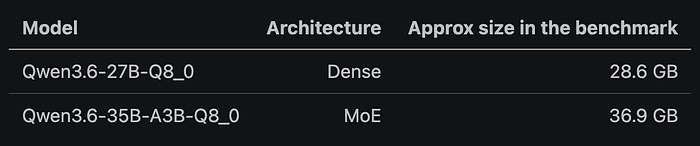
The main grid was:
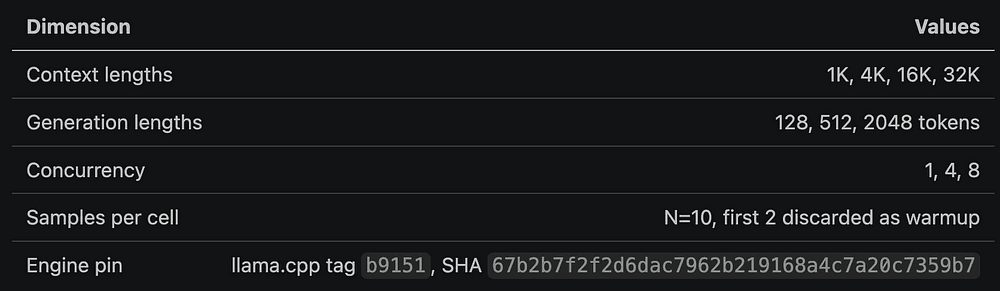
This is very important because local benchmarks become misleading fast when they mix quantization formats, runtime engines, and backend maturity.
MMBT explicitly separates these cases. Its aggregate/canonical-headline.csv table is the canonical same-source-SHA cross-host comparison, and appendix rows, including vLLM/FP8 and dual-card rows, live separately so readers do not accidentally mix apples and oranges.
Exactly the kind of discipline hardware discussions need.
A coding agent spends much of its time reading context, not writing final prose. It repeatedly ingests repository snippets, file trees, diffs, compiler output, test failures, linter messages, dependency manifests, issue descriptions, and prior tool-call state.
Every turn can look like this:
That loop creates three different latency surfaces.
A simple mental model is:
def estimate_latency(prompt_tokens, output_tokens, prefill_tps, decode_tps):
  prefill_seconds = prompt_tokens / prefill_tps
  decode_seconds = output_tokens / decode_tps
  return prefill_seconds + decode_seconds
That function is obviously incomplete. It ignores scheduling, cache hits, tool execution, network overhead, runtime batching, speculative decoding, prefix reuse, and queueing delay, but it is useful because it forces you to stop treating "tok/s" as a single number.
For an agentic coding product:
The right hardware depends on where your agent spends time.
The MMBT canonical 27B Q8 single-user table gives a clean starting point.
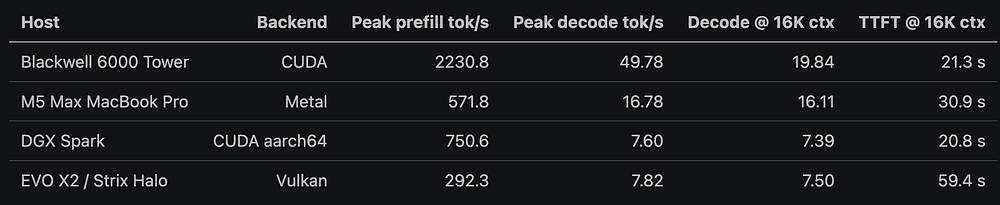
This table already tells a more useful story than "M5 beats Spark" or "CUDA wins."
The RTX PRO 6000 system wins peak single-user prefill and peak single-user decode, which should not surprise anyone.
The official NVIDIA RTX PRO 6000 Blackwell Workstation Edition spec lists 96 GB GDDR7 ECC memory, 1792 GB/s memory bandwidth, and 600 W max power consumption, which is a very different class of memory subsystem from laptop or mini-PC unified memory.
The M5 Max is strong for what it is.
Apple's M5 Max MacBook Pro technical specs list up to 128 GB unified memory and 614 GB/s memory bandwidth on the 40-core GPU configuration.
In the MMBT 27B Q8 row, it decodes much faster than Spark and Strix Halo at the short-context peak, and at 16K context it is surprisingly close to the RTX PRO 6000's measured llama.cpp CUDA decode rate.
The DGX Spark is not a raw single-node decode monster in this benchmark.
NVIDIA's DGX Spark hardware guide lists 128 GB LPDDR5x unified memory, a 256-bit interface, 273 GB/s memory bandwidth, a 20-core Arm CPU, ConnectX-7 networking, and FP4 support.
Spark is positioned as a desktop AI system for prototyping, fine-tuning, inference, and migration into NVIDIA infrastructure, which is also a different value proposition from "fastest local chat box."
Strix Halo is the budget-capacity story.
AMD's Ryzen AI Max+ 395 official specs list 128 GB max memory, a 256-bit LPDDR5x memory subsystem, and Radeon 8060S graphics with 40 graphics cores.
In MMBT, the tested EVO X2 gives you large unified memory at a lower price point, but the Vulkan row shows slow prefill and the small chassis shows thermal constraints.
So the top-level reading is:
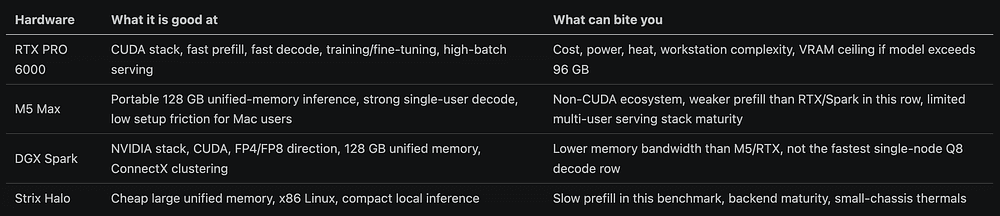
There is no permanent winner here, only operating points.
Single-stream LLM decode is often memory-bandwidth-bound.
For each new token, the system repeatedly streams model weights and attends over KV state. Compute can sit idle if memory cannot feed it fast enough.
Official and benchmark-relevant bandwidth numbers look like this:
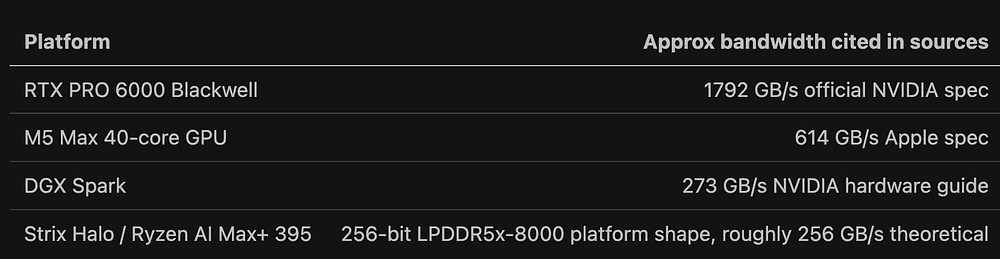
For dense Q8 single-user decode, this gives you the rough curve you would expect, but agentic systems complicate the picture.
At short context, the RTX PRO 6000 is far ahead. At 16K context, the MMBT llama.cpp CUDA row narrows: RTX PRO 6000 is around 19.84 tok/s while M5 Max is around 16.11 tok/s. At 32K context, the findings show the M5 row holding around 16 tok/s while the Tower row drops further under that specific llama.cpp CUDA setup.
That does not mean M5 magically has a faster GPU than the RTX PRO 6000. It means long-context behavior is runtime-sensitive.
The MMBT findings explicitly call out that multi-user and some long-context comparisons are engine-bound under llama.cpp and need separate vLLM, TensorRT-LLM, or MLX follow-up work.
Hardware specs explain a lot, but runtime implementation explains the rest.
Editor's note: Thank you for your support and for building alongside our articles. We recently released Compass: a blueprint of a production-grade customer support agent built to demonstrate how modern agent systems are actually engineered and operated in real environments. Compass is part of our Agent Foundry program and you can get it here completely for free.
Agentic developers should care about prefill more than casual chat users do.
A coding agent can issue dozens of turns. Each turn may include thousands or tens of thousands of tokens of accumulated context. If the system has poor prefix caching or frequent cache eviction, the same repository context can be reread over and over.
This is where "it streams fine once it starts" is not enough.
In the 27B Q8 single-user row:
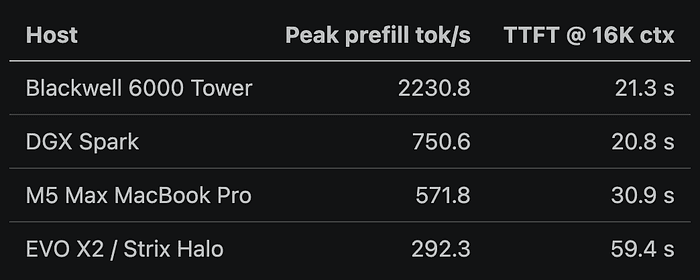
The Spark is interesting here. It loses to the M5 on decode in this dense Q8 row, but it has better 16K TTFT in the benchmark.
For tool-heavy agents, that can matter more than the raw streaming speed after the first token.
The most dangerous mistake is to extrapolate single-user numbers into multi-user agent serving.
The MMBT is also careful here. It ran concurrency cells, but it explicitly holds cross-host multi-user conclusions because llama.cpp's --parallel N behavior becomes an engine-level binding constraint at long context.
That is the right call.
Concurrent agent workloads are not just "single-user tok/s multiplied by N." They depend on:
This is where vLLM enters the discussion.
vLLM highlights continuous batching, prefix caching, chunked prefill, PagedAttention for KV memory management, optimized attention kernels, tensor/pipeline/data/expert/context parallelism, tool calling, reasoning parsers, and an OpenAI-compatible API server.
That feature set is built for serving.
llama.cpp is extremely useful because it runs almost everywhere. It supports local inference across a wide range of hardware, including Apple Silicon via Metal, x86 acceleration, CUDA, Vulkan, SYCL, and CPU+GPU hybrid inference.
That makes it a great cross-platform comparison tool, but a cross-platform comparison tool is not automatically the best production serving engine for high-concurrency agents.
For a developer team, the practical rule is:
Use llama.cpp to understand portability and baseline hardware behavior. Use vLLM, TensorRT-LLM, SGLang, MLX, or another optimized serving stack to evaluate production concurrency.
A local coding assistant for one developer can run happily on a single-user runtime. A team-wide agent service needs a serving engine.
DGX Spark looks weak if you reduce it to one Q8 decode row, but that is the wrong lens.
NVIDIA emphasizes the NVIDIA software stack, 128 GB unified system memory, FP4 support, fine-tuning up to 70B parameter models, inference with large models, and ConnectX networking that can connect two Spark systems for larger models.
The hardware guide lists two QSFP network connectors and ConnectX-7, which enables connecting two DGX Spark systems to work with AI models up to 405B parameters.
That does not make Spark faster than an RTX PRO 6000 in this single-node Q8 benchmark, but it does make Spark a developer appliance for teams that want to stay inside NVIDIA's stack, test local fine-tuning, validate deployment workflows, and potentially cluster two units.
For agentic AI product teams, Spark makes sense when the following are true:
In the MMBT benchmark, the 128 GB M5 Max MacBook Pro is genuinely strong for single-user local inference. It has enough unified memory to run large GGUF models, its decode numbers are healthy, and it held up thermally better than many people expected.
For small teams, the Mac has obvious advantages:
MLX is improving. llama.cpp Metal works, and there are local serving options.
But if your agentic product depends on CUDA-specific kernels, vLLM production behavior, TensorRT-LLM, NVIDIA quantization paths, or training/fine-tuning workflows that assume NVIDIA GPUs, the Mac is not a drop-in replacement.
The M5 Max is a great local inference machine when you value memory capacity, portability, and single-user convenience. It is a weaker choice when you are building a shared multi-agent serving platform.
It is fashionable to say the RTX PRO 6000 is overpriced, but it is also incomplete.
It has 96 GB GDDR7 ECC memory and 1792 GB/s memory bandwidth. In the MMBT single-user 27B Q8 row, the Blackwell 6000 Tower wins peak prefill and peak decode.
But the real reason RTX-class hardware matters for agentic AI is the combination of:
If your agentic product is a shared local service for a team, an RTX PRO 6000 is closer to "infrastructure" than "a fast local toy."
A platform team running many background agents, eval jobs, synthetic data generation, PR reviewers, embedding rerankers, and tool-using model workers can actually use the GPU.
This is the same distinction cloud teams already understand: GPU is expensive when idle but cheap when it is saturated by useful work.
So here is the practical buying logic.
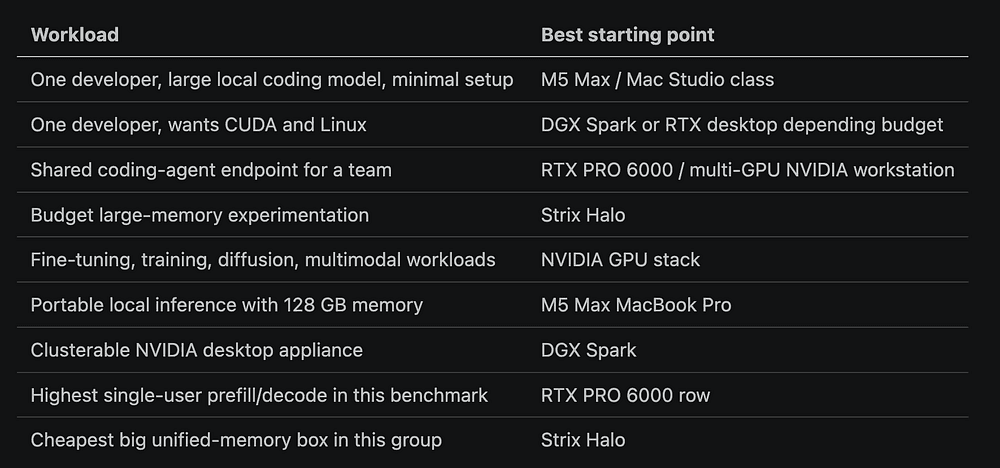
A second decision table is more useful for agentic systems:
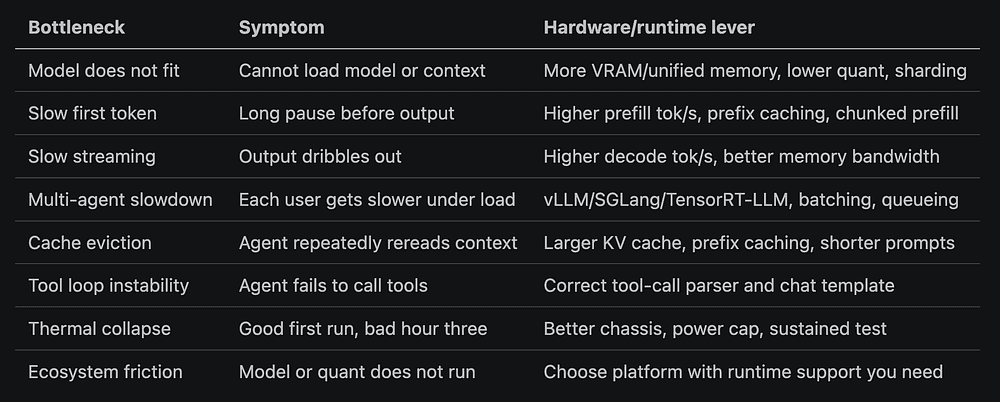
That table is the one you should take into procurement discussions.
For developer-focused agentic AI, the hardware ranking is a mapping:
Agentic AI turns model inference into systems engineering.
You need to think about model fit, prefill, decode, TTFT, batching, tool-call parsers, KV cache behavior, thermal stability, power, and reproducibility.
That is why the best local AI hardware discussion is:
Which bottleneck am I buying my way out of?
Answer that, and the hardware decision becomes much easier.