Observational Memory for Long-Running Agents “This wasn’t the plan!”
Agent Native•February 17, 2026
Always-on agents have unbounded context growth problem.
Tool calls can easily dump 50k tokens into your thread, and helpful traces and file scans metastasize.
And eventually your agent flips into compaction / summary mode and starts making decisions based on… what, exactly?
I’ve been burned by this enough times that I now treat memory as a first-class system.
Observational Memory (OM) is Mastra’s approach to long-context agent memory.
Instead of dragging raw message history forever, OM maintains an observation log built by two background workers:
Observer: watches the conversation + tool outputs and writes structured observations
Reflector: merges related observations, extracts patterns, and condenses aggressively
Context window stays stable and prompt-cacheable as your agent runs for hours/days.
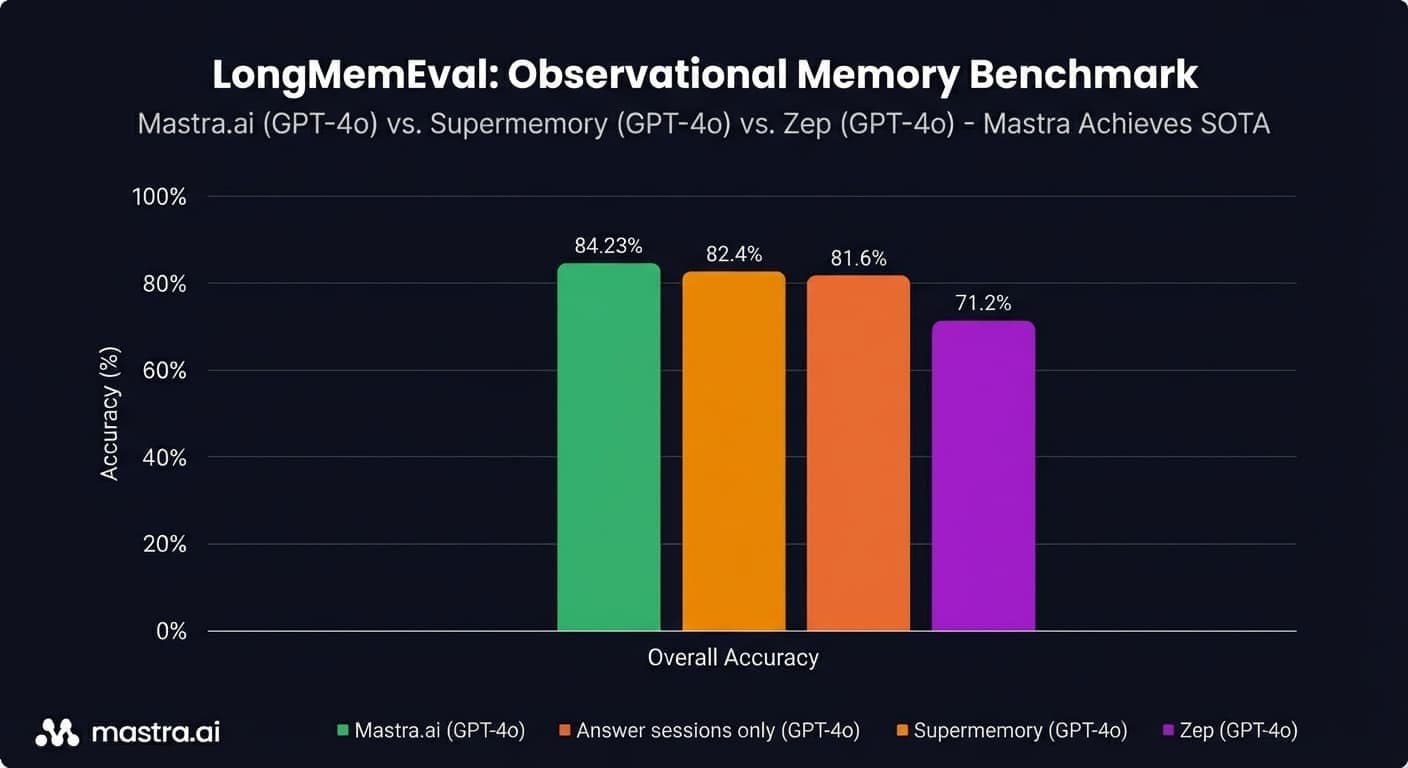
In LongMemEval, OM even beats a gpt-4o “oracle” setup (the one that gets only the answer sessions) by ~2 points.
Surprisingly, we find long-context LLMs show a 30%∼60% performance drop on LongMemEvalS, and manual evaluations reveal that state-of-the-art commercial systems (such as GPT-4o) only achieve 30%∼70% accuracy in a setting much simpler than LongMemEvalS. Even the most capable long-context LLMs currently would require an effective memory mechanism to manage an ever-growing interaction history.
OM is one of the practical answers to “How do you give an agent long-term memory without paying RAG tax on every turn and without letting tool outputs rot your context?”
In this article, I’ll walk you through its wiring, thresholds, and the failure modes you’ll actually see in production.
What we’re talking about (in one sentence)
Observational Memory (OM) is an agent memory system where background agents continuously compress raw message history into a dense log of observations, and periodically garbage collect those observations so your main agent remembers without explicitly querying memory, and without dynamic retrieval.
They built it with 3 things in mind.
1) Tool calls are exploding context windows
Modern agents don’t just chat. They browse, screenshot, scan repos, execute commands, and run deep research in parallel. Those tool results are often massive.
For example, browser agents using Playwright + screenshots, coding agents scanning files + executing commands, deep research agents browsing multiple URLs in parallel.
2) Prompt caching went from “nice” to “mandatory”
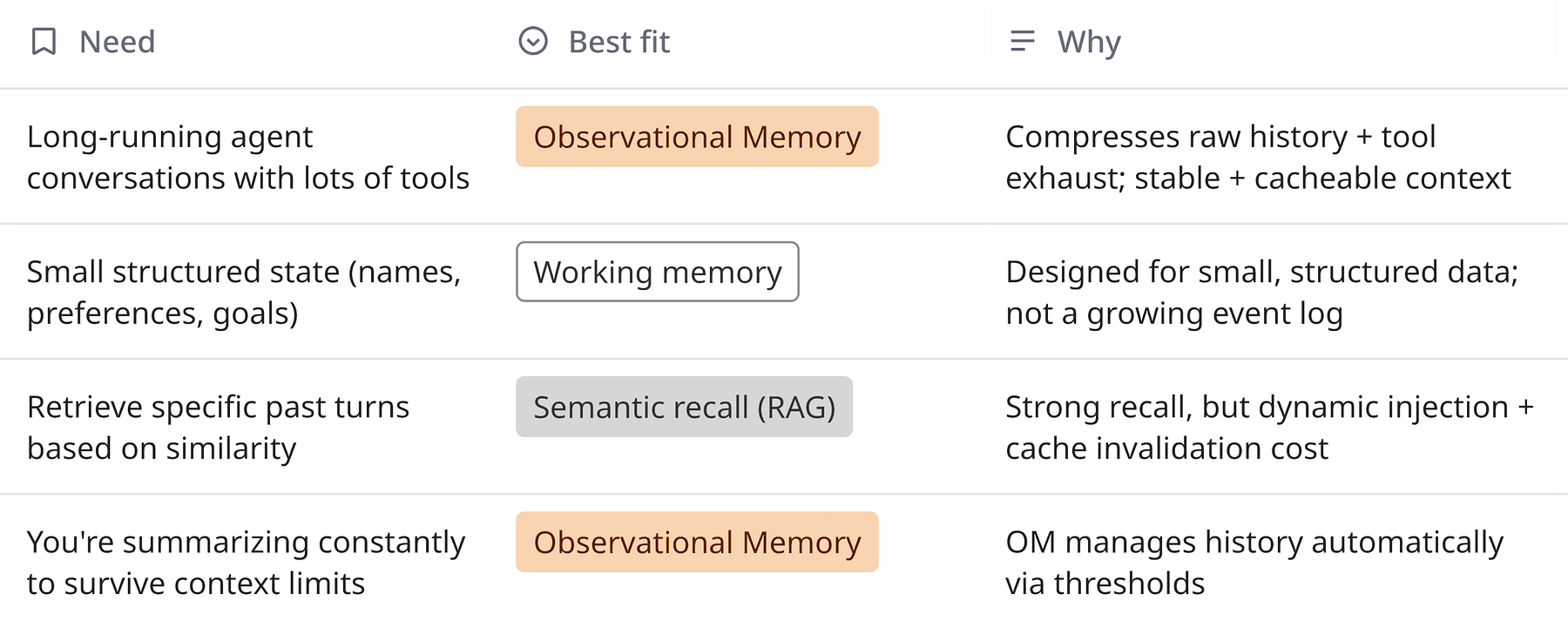
Traditional RAG-based “memory” injects dynamic context every turn (embed >> retrieve >> inject). That is great for recall, but it invalidates your prompt cache constantly.
In OM, the context is designed to be predictable and stable so you can get full cache hits on most turns, and partial cache hits even when observations update.
3) Bigger context windows did not solve “context rot”
General background knowledge (stable): Even if a model supports a huge context window, performance often degrades as the window fills with irrelevant or noisy tokens (“context rot”). You don’t just need “more tokens.” You need better tokens.
OM is explicitly trying to make small context windows behave like large ones by keeping the context dense and relevant.
What is Observational Memory, mechanically?
OM splits context into two blocks:
Observations (memory), a log of what happened, condensed
Raw message history, the most recent conversation turns that haven’t been condensed yet
Messages append to block #2 until you hit a threshold. Then an Observer agent compresses those messages into observations, appends them to block #1, and drops the original messages.
When observations grow too large, a Reflector agent garbage collects them by combining duplicates, dropping low-value stuff, and reorganizing into a tighter representation.
The core claim is very specific:
The main agent never queries memory.
The main agent never writes memory.
Background agents do the compression and cleanup.
The result is a stable prompt prefix that stays cacheable.
Observations look like logs on purpose
OM uses a log-like format instead of structured objects:
Formatted text, not JSON objects or knowledge graphs
A three-date model for better temporal reasoning: observation date, referenced date, relative date
the memory system must enable correct answers across sessions
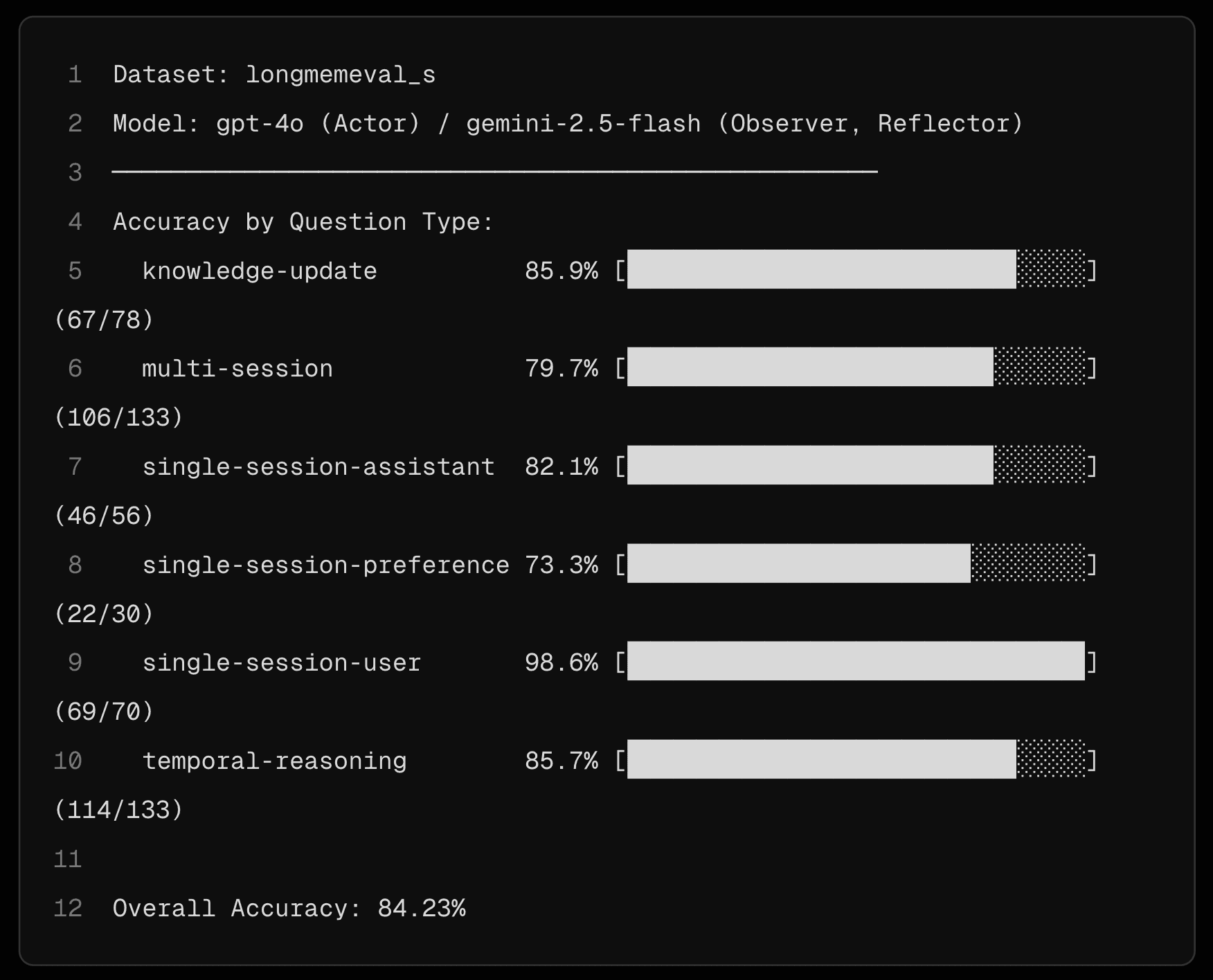
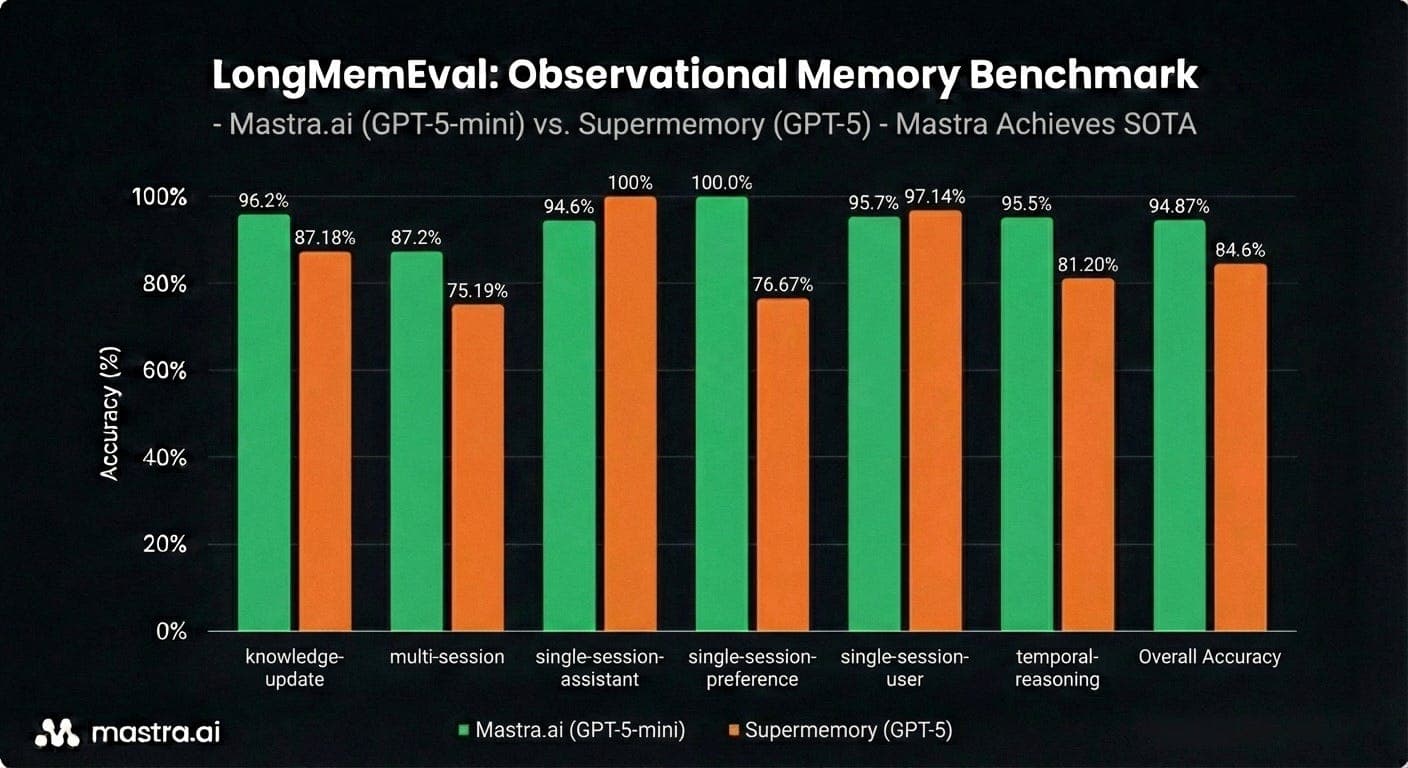
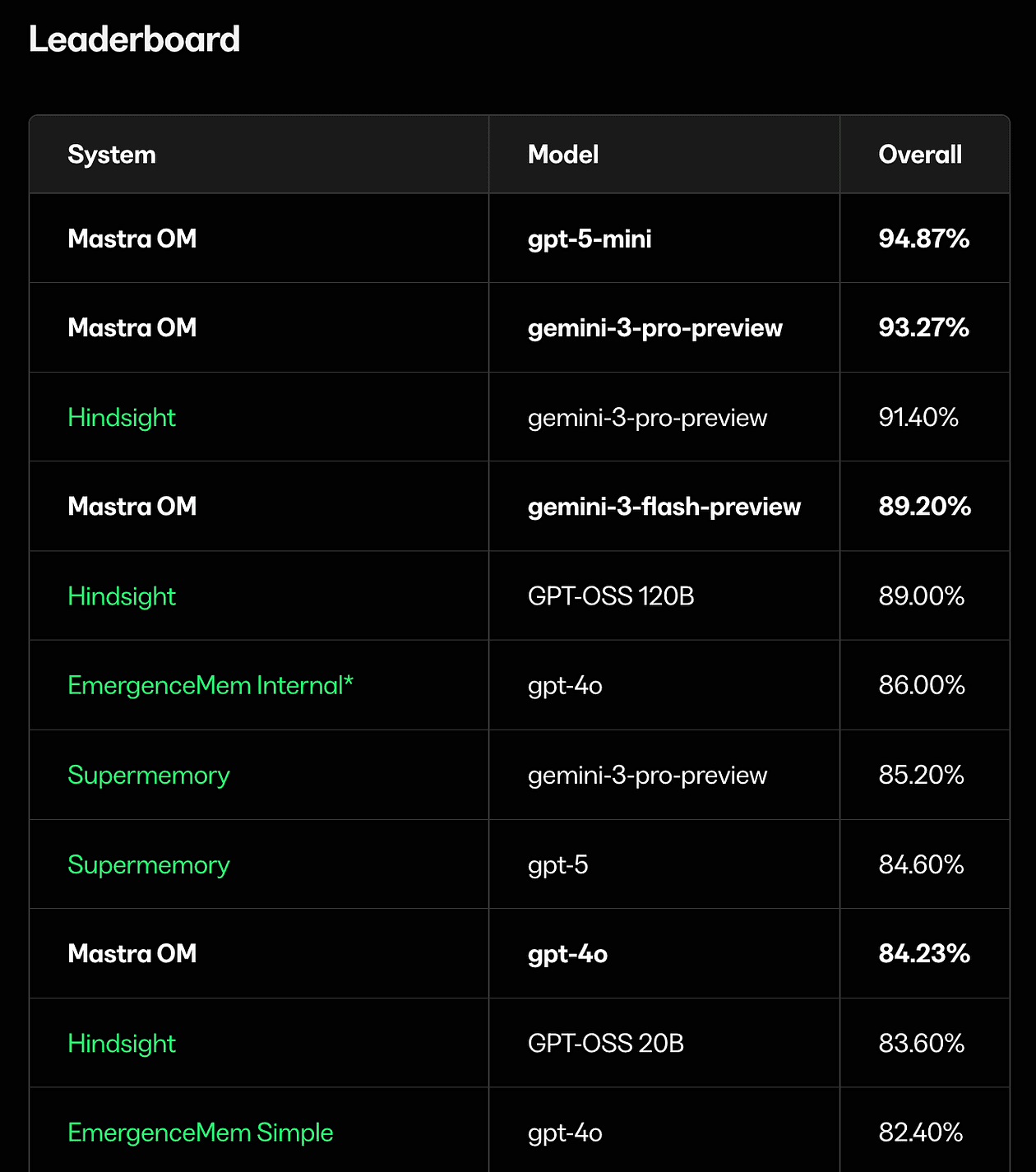
Mastra OM hits 94.9% on LongMemEval with gpt-5-mini (highest recorded score)
84.2% with gpt-4o, beating:
the oracle (82.4%), which only includes the answer sessions
the previous gpt-4o SOTA from Supermemory (81.6%)
Mastra RAG (80.05%)
Zep (71.2%)
full-context baseline (60.2%)
There are two non-obvious implications here:
Compression can increase accuracy: OM can be better memory than raw transcripts, because it strips noise.
Stable context is not a performance tax: Most systems pay for recall by changing the prompt every turn. OM gets high recall while keeping the prompt stable.
How Observational Memory helps
Let’s talk about real failure modes.
My agent forgets, but only after it uses tools
You start with a clean conversation. The agent runs a repo scan or a browser step. Suddenly the context window is full of junk and the model’s next answer feels… off.
OM directly targets that by compressing tool-heavy history into a few hundred tokens of observations.
For example Playwright MCP can generate 50,000+ tokens per page snapshot. OM turns that into a few hundred tokens about what was on the page and what actions were taken.
RAG memory is accurate, but too expensive in production
Semantic recall using RAG scores well, but it’s expensive and constantly invalidates prompt cache. OM aims to keep performance high and costs sane.
Compaction nukes continuity
OM is designed to make continuity feel “human-like,” because it preserves the high-signal narrative instead of bluntly summarizing everything.
Quick start
Let’s have a look at few usage examples.
Code
python
import { Memory } from "@mastra/memory";
import { Agent } from "@mastra/core/agent";

export const agent = new Agent({
name: "my-agent",
instructions: "You are a helpful assistant.",
model: "openai/gpt-5-mini",
memory: new Memory({
  options: {
    observationalMemory: {
      observation: {
        model: "google/gemini-2.5-flash",
      },
      reflection: {
        model: "openai/gpt-4o-mini",
      },
    },
  },
}),
});
That’s it.
With observationalMemory: true, Mastra defaults the observer/reflector model to google/gemini-2.5-flash.
You can customize the observer/reflector model.
Code
python
import { Memory } from "@mastra/memory";
import { Agent } from "@mastra/core/agent";

export const agent = new Agent({
name: "my-agent",
instructions: "You are a helpful assistant.",
model: "openai/gpt-5-mini",
memory: new Memory({
  options: {
    observationalMemory: {
      model: "openai/gpt-4o-mini",
    },
  },
}),
});
You can also tune token budgets
Code
python
import { Memory } from "@mastra/memory";
import { Agent } from "@mastra/core/agent";

export const agent = new Agent({
name: "my-agent",
instructions: "You are a helpful assistant.",
model: "openai/gpt-5-mini",
memory: new Memory({
  options: {
    observationalMemory: {
      shareTokenBudget: true,
      observation: {
        messageTokens: 20_000,
        bufferTokens: false, // required when using shareTokenBudget (temporary limitation)
      },
      reflection: {
        observationTokens: 80_000,
      },
    },
  },
}),
});
I suggest to start with defaults unless you have a reason not to. They’re conservative and still hit SOTA.
If you’re currently stuffing ongoing state that grows over time into working memory, OM is definitely a better fit.
Shipping OM without getting paged
If you are rolling this into a production agent tomorrow:
Start with thread scope: Resource scope is tempting, but it’s explicitly experimental for task continuity.
Keep defaults for thresholds at first (30k / 40k): They’re conservative and already hit SOTA.
Use async buffering unless you enjoy random pauses: Disable only if you have a strong reason.
Pick a background model that’s consistent and has context headroom
Default is gemini-2.5-flash. Avoid Claude 4.5 for observer/reflector for now.
Treat tool output as toxic waste: If your agent is a heavy tool user (Playwright screenshots, repo scans), OM is disproportionately valuable.
Thoughts
The frontier is:
better task adherence across threads
better safety against prompt injection in long-lived memory logs
better developer ergonomics for inspecting what the agent believes
If dense observations can beat raw transcripts, what else are we overfeeding models that we should compress aggressively (tool outputs? intermediate plans? retrieved docs)?
If you’re building agents with real tools and real users, I’d love to hear what’s currently breaking your memory, and whether the failure mode is recall, cost, or plain old context rot.