GET SHIT DONE: Meta-prompting and Spec-driven Development for Claude Code and Codex
Agent Native•February 23, 2026
GSD (“Get Shit Done”) aims to solve context rot, the quality degradation as the model’s context window fills.
The fix is to stop treating a single chat thread as your build system.
GSD forces the work into small, checkable plans and runs each plan in a fresh context window, with atomic git commits per task so you can bisect your way out of agent chaos.
In this post, I’m going to unpack what GSD actually is, why it shows up now, and the parts I think are genuinely non-obvious, like the “discuss phase” step that locks in product decisions before planning, and the Nyquist validation layer that tries to make sure you have a test feedback loop before you write the code.
I’ll also give you concrete patterns you can steal even if you never install GSD.
Context first, tools second
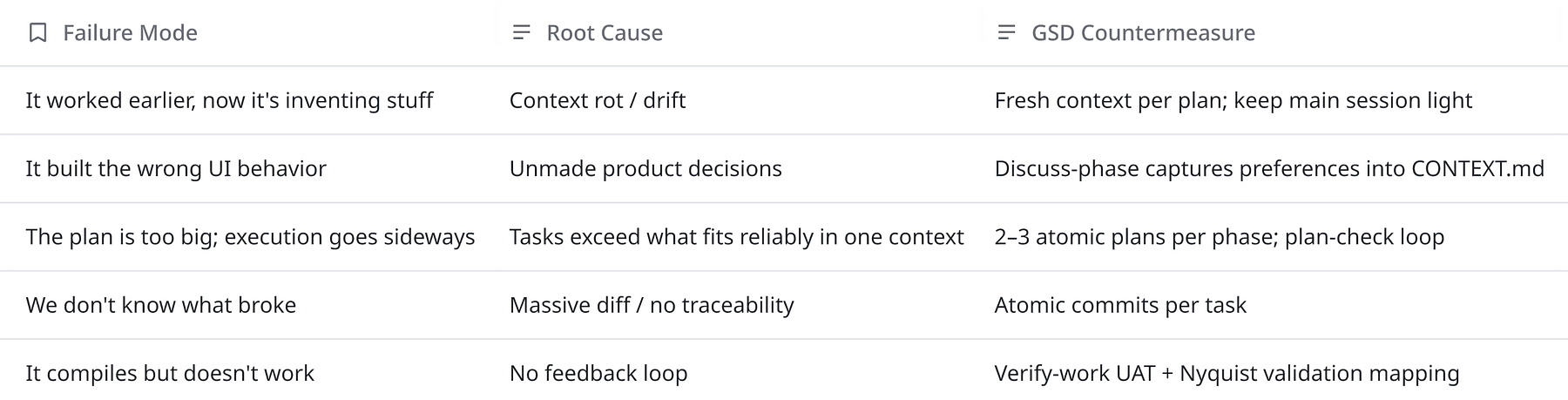
AI coding assistants write thousands of lines while you review, and you have to understand the failure modes.
You typically lose time to:
Long-session drift where the agent slowly forgets constraints
Invisible decision loss where you agreed on a pattern but agentstops following it
Unreviewable diffs where agent makes one giant commit without narrative or rollback points
Fake progress where agent writes lots of code but produces a little working product
Because of these reasons, GSD is built as the context engineering layer that makes Claude Code and other runtimes more reliable, by designing a workflow around fresh contexts, externalized state, and verification.
It supports Claude Code, OpenCode, Gemini CLI, and Codex, and it ships as an installer you run via npx.
It’s also evolving fast and there are frequent releases, actively fighting real-world edge cases (health checks, auto-advance chaining, context window monitoring, plan verification gates, requirements traceability, etc.).
GSD in one sentence
GSD is a spec-driven development workflow + prompt/agent harness that tries to prevent context rot by externalizing state into files, splitting work into small plans, executing each plan in a fresh context, and verifying output against explicit goals.
It wraps AI coding tools with:
A consistent artifact set (PROJECT.md, REQUIREMENTS.md, ROADMAP.md, STATE.md, per-phase plans, summaries, verification reports, etc.)
A phase-based workflow (discuss → plan → execute → verify, repeat)
Multi-agent orchestration (specialized agents for research, planning, execution, verification; thin orchestrator ties it together)
This produces a {phase}-CONTEXT.md file that feeds the researcher and planner.
3) Plan: /gsd:plan-phase N
Code
bash
/gsd:plan-phase 1
Planning has three explicit pieces:
Research (guided by your phase context)
Plan creation (2–3 atomic tasks)
Plan verification (loop until pass, up to a limit)
The goal is to produce plans that are small enough to execute in a fresh context window.
GSD uses XML prompt formatting for each plan, with explicit verification steps baked in.
Code
xml
<task type="auto">
<name>Create login endpoint</name>
<files>src/app/api/auth/login/route.ts</files>
<action>
  Use jose for JWT (not jsonwebtoken - CommonJS issues).
  Validate credentials against users table.
  Return httpOnly cookie on success.
</action>
<verify>curl -X POST localhost:3000/api/auth/login returns 200 + Set-Cookie</verify>
<done>Valid credentials return cookie, invalid return 401</done>
</task>
That structure is collapsing ambiguity.
4) Execute: /gsd:execute-phase N
Execution is where GSD leans hardest into fresh context or bust.
Code
bash
/gsd:execute-phase 1
It runs plans in dependency-based waves:
Parallelize independent plans
Sequence dependent plans
Avoid file conflicts by adjusting grouping
And for each plan, it uses a fresh context window so the executor isn’t polluted by whatever happened earlier.
Then it creates atomic commits per task which is an observability and rollback mechanism for AI automation.
Code
bash
┌─────────────────────────────────────────────────────────────────────┐
│  PHASE EXECUTION                                                    │
├─────────────────────────────────────────────────────────────────────┤
│                                                                     │
│  WAVE 1 (parallel)          WAVE 2 (parallel)          WAVE 3       │
│  ┌─────────┐ ┌─────────┐    ┌─────────┐ ┌─────────┐    ┌─────────┐  │
│  │ Plan 01 │ │ Plan 02 │ →  │ Plan 03 │ │ Plan 04 │ →  │ Plan 05 │  │
│  │         │ │         │    │         │ │         │    │         │  │
│  │ User    │ │ Product │    │ Orders  │ │ Cart    │    │ Checkout│  │
│  │ Model   │ │ Model   │    │ API     │ │ API     │    │ UI      │  │
│  └─────────┘ └─────────┘    └─────────┘ └─────────┘    └─────────┘  │
│       │           │              ↑           ↑              ↑       │
│       └───────────┴──────────────┴───────────┘              │       │
│              Dependencies: Plan 03 needs Plan 01            │       │
│                          Plan 04 needs Plan 02              │       │
│                          Plan 05 needs Plans 03 + 04        │       │
│                                                                     │
└─────────────────────────────────────────────────────────────────────┘
5) Verify: /gsd:verify-work N
This is manual UAT with structured help:
Extract testable deliverables
Walk you through each (“Can you log in with email?”)
If something fails, it spawns debug agents and generates fix plans for re-execution
/gsd:verify-work 1
This is exactly where vibe coding dies in production if not verified.
6) Milestones: audit and ship
GSD treats milestones as cycles:
/gsd:audit-milestone
/gsd:complete-milestone (archive + tag)
/gsd:new-milestone (start the next version cycle) (GitHub)
This is a “release management” for solo developers, without pretending you need sprint theater.
Quick mode: /gsd:quick
For ad-hoc tasks, quick mode gives you the guarantees (state tracking, atomic commits) without the full research/plan-check/verifier loop.
How is this helpful in the real world?
It turns agent output into engineering artifacts
The most practical part of GSD is the file system.
It’s generating the scaffolding that makes code reviewable:
Project vision that stays loaded (PROJECT.md)
Requirements with v1/v2 scope (REQUIREMENTS.md)
Roadmap phases (ROADMAP.md)
Decisions and blockers (STATE.md)
Per-task plans + summaries + verification outputs
It constrains the blast radius
Atomic commits mean:
git bisect can isolate the task that broke things
reverts are surgical
future agent sessions can reason about history more cleanly
This is a big deal because agent regressions are often non-local. The model changes five files to help, and you don’t know which change mattered. Small commits are the antidote.
3) It makes parallelism real
GSD’s wave model gives you a concrete way to parallelize tasks while respecting dependencies.
Vertical slices parallelize better than horizontal layers.
That’s just good engineering and it becomes critical when you have multiple executors writing code concurrently.
4) It forces you to decide
Most misalignment is because you never specified the product decision and the model guessed.
GSD makes that guess-work explicit, and gives you a place to pin decisions into a context file that later stages must read.
5) It introduces a quality gate before coding (Nyquist validation)
This is the spiciest idea and it’s easy to miss.
During plan-phase research, GSD can map automated test coverage to each requirement before code is written, producing a {phase}-VALIDATION.md feedback contract.
The plan-checker treats missing verify commands as a failure condition.
Code and config
One thing I like is that GSD surfaces workflow tradeoffs as config.
The user guide describes .planning/config.json with toggles for research, plan-checking, verifier, Nyquist validation, and model profile selection.
Here’s a simplified version you can paste as a starting point:
Those exact fields and defaults are documented in the user guide, including a scenario table (prototyping vs production) and model-profile breakdown by agent.
Why spec + verify works
In classical software engineering, we get reliability from tight feedback loops:
unit tests (fast feedback on logic)
integration tests (feedback on boundaries)
CI (repeatable truth machine)
code review (human judgment)
observability (production feedback)
Since agentic coding is just software engineering with a new failure mode (e.g., the coder is non-deterministic and sometimes overconfident), the stable principle is:
The more autonomous the code generator, the more you must invest in verification, traceability, and rollback.
GSD’s Nyquist validation idea is basically this principle applied early, don’t let the agent write code for requirements you can’t verify quickly.
However there are few caveats.
You’re generating and maintaining planning artifacts. That can be a feature or a tax. The config includes commit_docs and notes around .gitignore interactions for a reason.
Discuss-phase helps, but it doesn’t eliminate ambiguity, you just moved it into a structured conversation. If you don’t know what you want, you can’t outsource that to a model, and if the agent can run shell commands and commit to your repo without friction, your security posture needs to match that reality.
Concluding thoughts
GSD has a few important contributions:
Context is a consumable resource.
Memory belongs in files, not in a chat thread.
Work should be sliced to fit into fresh contexts.
Verification must be attached to tasks, not bolted on later.
Git history is part of system observability.
This makes you to think what kind of engineering org you are:
Are you a developer chatting with a tool?
Or are you a developer operating a build system where the code generator is non-deterministic?
GSD assumes the second, that’s why it feels heavier than a prompt, and why it tends to feel more reliable than a raw chat.