Opening the post0.0s
8 min read
Before any Claude fans boo me: I’m not claiming “M2.5 is Opus” but the pricing + throughput + agent-oriented training forces a new engineering question:
If frontier-ish reasoning is cheap enough to run “always-on”… what’s the bottleneck now?
MiniMax launched MiniMax-M2.5 with two commercial variants:
Anthropic lists Claude Opus 4.6 starting at $5/$25 per 1M input/output
So the clean “95% cheaper” statement is:
One thing is very clear, with inference prices this low, it’s the best time to be a developer running agents on a budget.
MiniMax’s own line is: ~$1/hour at 100 output tokens/sec, and ~$0.30/hour at 50 tokens/sec.
At 100 output tokens/sec:
$1/hour assumes continuous generation, which is not how most agents behave (agents are bursty; tools and I/O dominate wall time). But it’s still a useful mental model because it tells you: .
But what about the real-world performance? Is this another benchmark too good to be true?
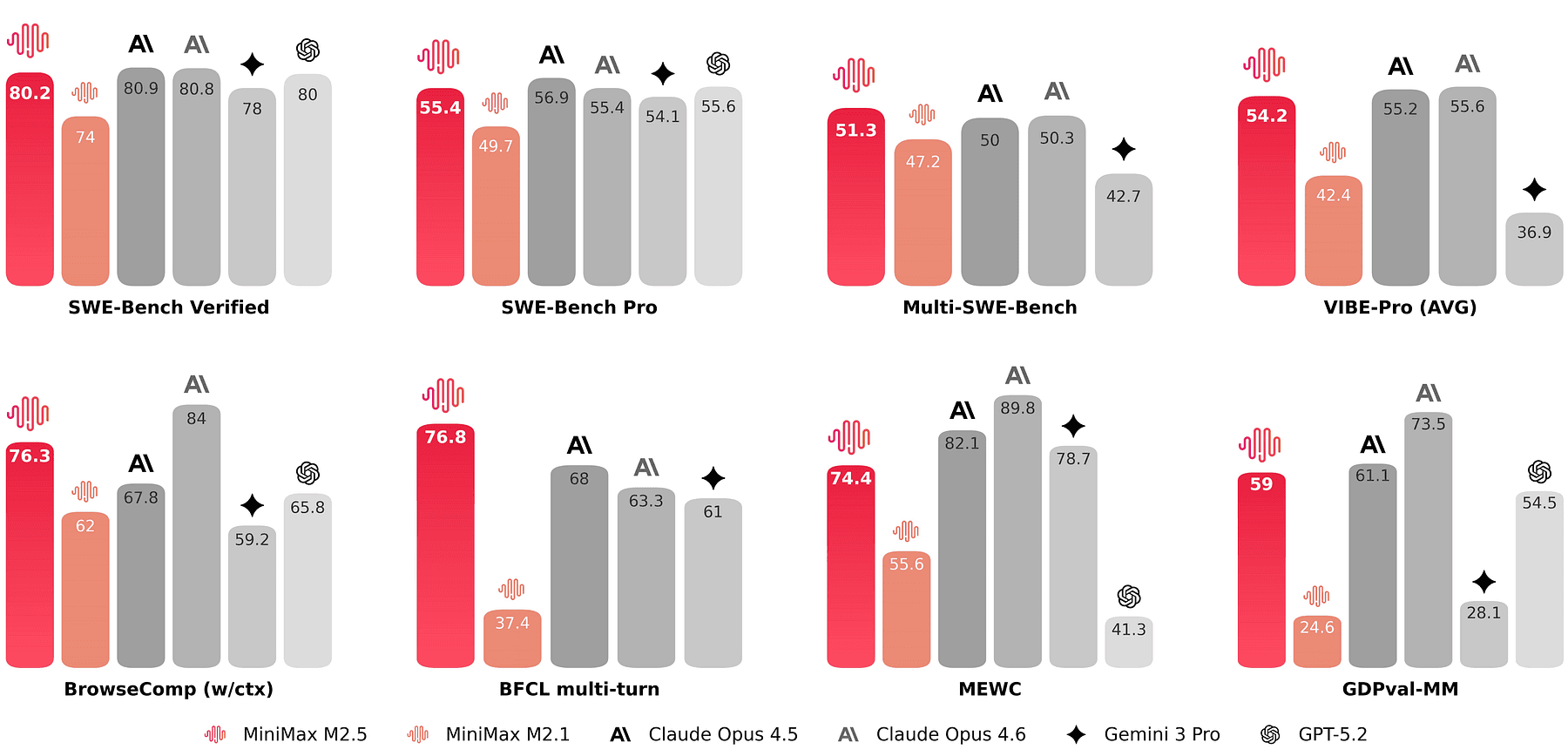
Sir, MiniMax just dropped MiniMax M2.5 and it’s on par with Opus 4.6 while being 20x cheaper.

MiniMax highlights 80.2% on SWE-bench Verified, plus strong tool-use / search numbers, and they explicitly push “agent harness generalization” as a feature
Two benchmark realities matter here:
SWE-bench Verified is a 500-instance human-validated subset intended to be higher quality than the full set.
But static benchmarks age poorly.
That’s exactly why SWE-rebench is designed to be continuously refreshed and decontaminated, and the authors explicitly argue that performance on older static sets can look inflated when training overlap/contamination creeps in.
So SWE-bench Verified sometimes can reflect model memory/training overlap more than general agent ability.
You can see that Opus 4.6 is the leader in SWE-rebench while Chinese models are not even in top 10.
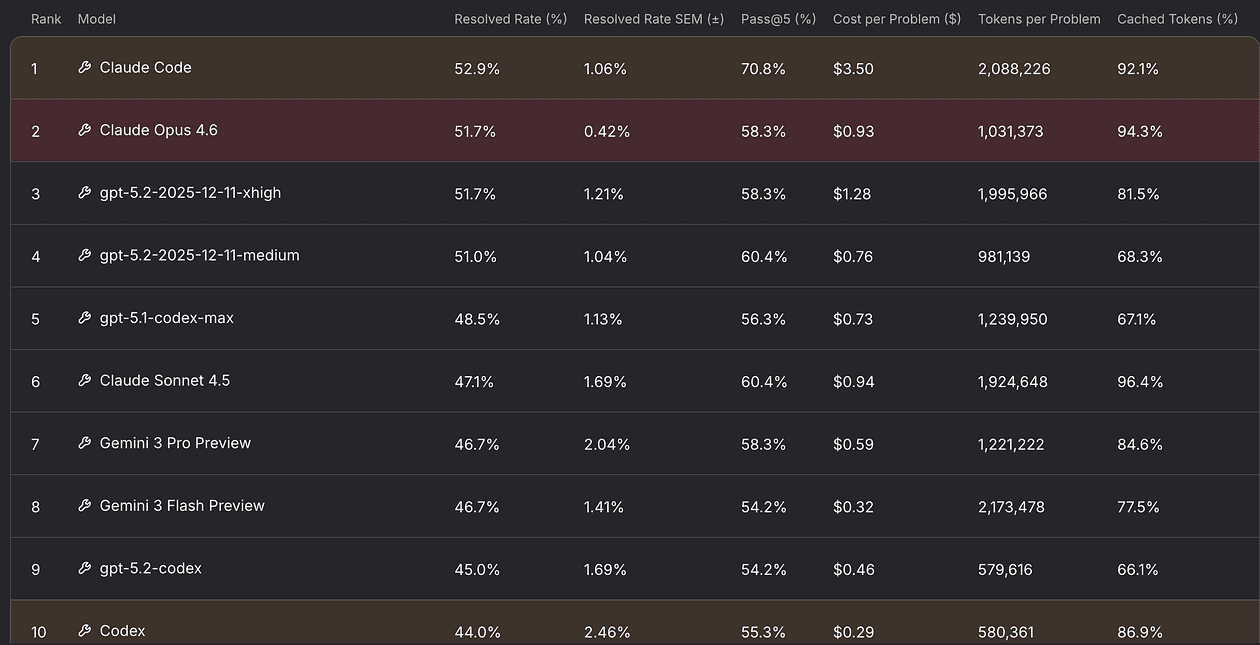
This shouldn’t mislead you though, because model distillation is still a great technique and results in very performant models.
To me and many others, Opus 4.6 (and Codex 5.3) still has an edge but not everyone agrees, if you browse social media for 15 minutes, you will see a lot of comments:
It’s so much cheaper than Claude and imo just as good as Opus.
So just for a second, if we assume that’s true, that we can get SOTA performance at much cheaper price point, there is a much bigger question that we have to deal with:
When a frontier-ish model can run continuously for ~$1/hour at ~100 tokens/sec, “What’s the real bottleneck now?”.
So I think the right takeaway from benchmark numbers is not SOTA confirmed, it’s:
This model was trained and measured in agent-style loops, now you must verify stability + tool reliability in your own harness.
If you can run a frontier-ish model at “always-on” economics, architecture changes more than budgets, because the cheaper the model gets, the more your bottleneck becomes:
That’s the part benchmarks don’t measure well.
M2.5 tends to decompose and plan like a software architect before coding, emerging during training.
If you’ve built AI coding features, you know why this matters.
When a model naturally writes a plan/spec first, you can turn that into:
MiniMax team highlights evaluation on SWE-Bench Verified across different harnesses (Droid, OpenCode), framing it as “out-of-distribution harness” generalization.
This is also huge:
If the model only works inside one vendor’s agent scaffolding, you don’t have a model, you have a hard product dependency.
Multiple comments + the extra transcript call out a pattern: models like this can be impressive, but sometimes:
In other words variance, which wrecks developer trust.
M2.5 is being distributed broadly (API + open weights), and the ecosystem will quickly normalize access through standardized interfaces.
The open vs closed debate becomes less important than:
Can you swap models without waking someone up at 2am?
Local running is already feasible for some setups via:
For example, an MLX 3-bit conversion exists and reports ~229B params and ~100GB size.
One useful data point is adversarial probing of behavior and refusal boundaries.
Eric Hartford noted, when comparing M2.5 vs Kimi-K2.5 on China-sensitive prompts, that the two models appear to differ in refusal behavior, and that both can “gaslight when pressed,” while he works on mapping the refusal space at scale.
This is important because:
Benchmarks are not useless but the context itself basically tells you why they’re insufficient:
So here’s a practical eval plan that matches those risks.
1) Measure variance, not just average quality
Run the same prompts N times and score:
If “half the time it gets something really weird”, that’s a product decision.
2) Test whole workflows, not tasks
MiniMax team emphasizes “full development lifecycle” and office deliverables. Test that claim with your real workflow:
Take one internal service change request and see if it can:
3) Stress tool use with unfamiliar scaffolds
They explicitly brag about stability in unfamiliar scaffolding environments. Verify it.
4) Evaluate world knowledge where it matters
The transcript shows “Stonehenge” / “Spongebob” style tests. Silly, but diagnostic.
In products, “world knowledge” becomes:
So pick a narrow domain where being “30% off” is catastrophic (finance, legal, healthcare) and test it with ground truth.
5) Put cost after reliability in your scoring
This is the trap with M2.5-style pricing. You’ll optimize for cost and then spend the savings on engineering time debugging instability.
A simple scoring function:
When NOT to do this: if you’re building something explicitly “best effort” (e.g., internal ideation tools). Then cost can matter more.
Based on the context alone, I’d summarize the moment like this:
So if you’re building AI features right now, my slightly opinionated advice is:
Don’t bet your product on any single model, bet on a stack that makes model choice reversible.
Implement a router + fallback path, and start logging:
Then you can adopt models like M2.5 aggressively without taking on existential risk.