Deep Research with 96,000+ Trajectories — Completely Offline
Agent Native•February 10, 2026
Imagine synthesizing human-like research trajectories exceeding 100 turns entirely offline, no reliance on search or scrape APIs, no rate limits, and crucially, no nondeterminism.
If you could do that, you would get fully reproducible, scalable research workflows without the usual bottlenecks of online services.
That would save you API rate limits, randomness and brittle scrappers.
OpenResearcher solves all that by building a massive offline corpus paired with a local retriever and a powerful 120-billion-parameter GPT model.
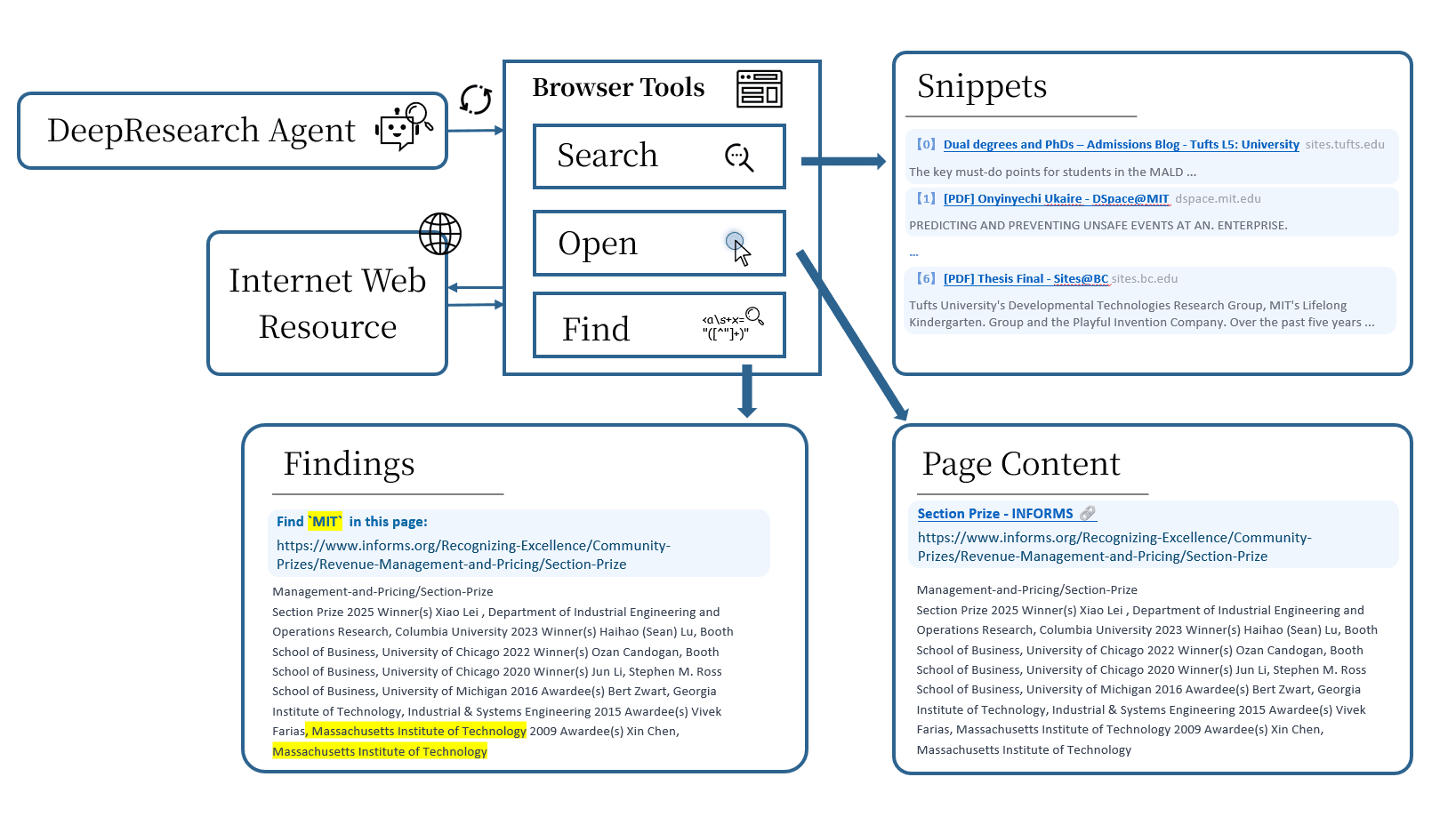
This trio enables realistic, long-horizon “browsing-like” tool-use traces that mimic **search > open > find** behaviors you’d expect from a human researcher exploring the web.
This effectively unlocks new possibilities:
Training models on deep, multi-step reasoning over vast knowledge bases
Avoiding the unpredictability of live web data during experiments
Scaling research synthesis without API quotas or cost concerns
OpenResearcher’s offline pipeline includes a colossal 10T token corpus containing 15M curated FineWeb documents plus 10K gold-standard passages bootstrapped once for quality and coverage.
It then generates realistic trajectories filtered by reject sampling to keep only successful, high-quality research paths.
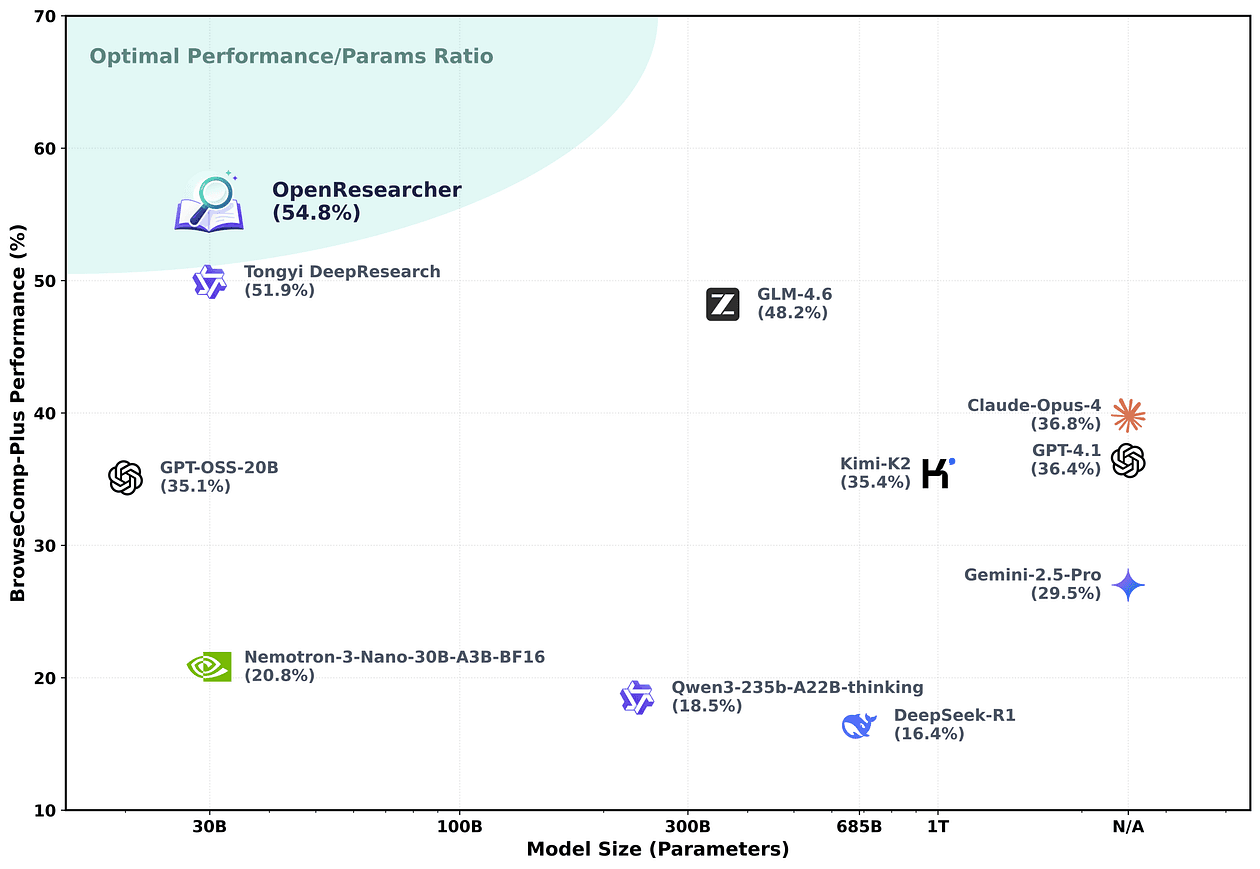
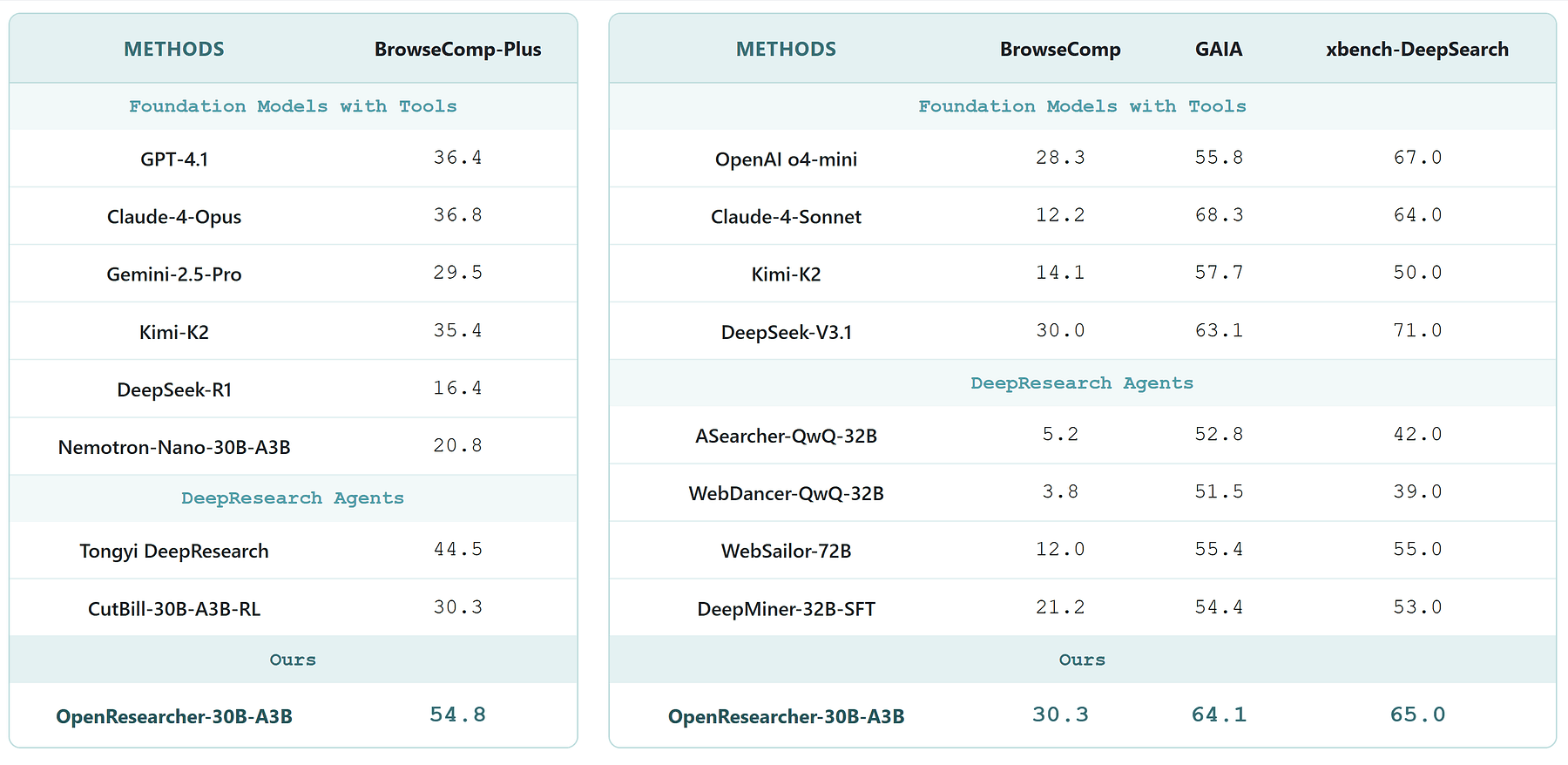
Fine-tuning on OpenResearcher-generated data boosts the Nemotron-3-Nano-30B-A3B model’s accuracy on the BrowseComp-Plus benchmark from a meager 20.8% to a robust 54.8%, a +34.0 point jump.
In this article, I will break down how OpenResearcher’s architecture, trajectory generation, data filtering, and corpus construction work together to deliver these gains and what you can do tomorrow to start building on this foundation.
Core Architecture: GPT-OSS-120B, Local Retriever, and Offline Corpus
OpenResearcher’s technical foundation is a deliberate assembly of three heavyweight components designed for scalable, reproducible, and deep research synthesis, and all offline.
GPT-OSS-120B: The Language Backbone
OpenResearcher uses GPT-OSS-120B, a 120-billion-parameter open-source large language model tailored for research tasks.
Unlike smaller models or black-box APIs, GPT-OSS-120B provides the raw generative power needed to reason over complex, multi-step queries spanning diverse scientific domains.
It’s the engine that synthesizes and composes knowledge, but it needs context, this is where retrieval comes in.
Local Retriever: Fast, Deterministic Access to Knowledge
OpenResearcher pairs GPT-OSS-120B with a local retriever system.
This retriever indexes the offline corpus and supports rapid, deterministic lookups during generation.
Instead of querying live web APIs, which are often plagued by rate limits, network latency, and nondeterminism, the retriever operates entirely offline, ensuring repeatable experiments.
This local retrieval mechanism feeds GPT-OSS-120B the most relevant documents or passages from the corpus before each generation step.
The retriever’s design balances precision and recall, enabling the model to search the offline knowledge base efficiently and mimic realistic browsing behaviors (**search > open > find**) without ever connecting online.
The 10 Trillion Token Offline Corpus
The offline corpus is the third pillar.
It boasts an immense scale of roughly 10 trillion tokens, comprising 15 million curated FineWeb documents plus 10,000 gold-standard passages.
This corpus is the knowledge reservoir that the retriever taps into. Because it’s static and fully offline, it eliminates the unpredictability of live web data, enabling consistent training and evaluation.
The corpus is structured to support deep, multi-turn research trajectories by providing comprehensive coverage and fine-grained evidence passages.
Resources and Tools Provided by OpenResearcher
OpenResearcher is a fully open ecosystem designed for AI builders who want to experiment, iterate, and build on top of a reproducible, offline research synthesis pipeline.
Here’s what you get out of the box:
Codebase and Pipeline: The entire OpenResearcher code is available on GitHub, including the logic for trajectory generation, local retrieval, and integration with GPT-OSS-120B.
Local Search Engine: OpenResearcher releases a local retriever engine optimized for fast, deterministic lookups across the massive offline corpus.
Corpus Recipe and Dataset: You get the recipe to build the 10 trillion token offline corpus, including the 15 million FineWeb documents and 10,000 gold-standard passages.
Trajectory Datasets: Over 96,000 realistic, long-horizon research trajectories are released.
Evaluation Logs: OpenResearcher provides comprehensive evaluation logs that document model performance across BrowseComp-Plus and other benchmarks, enabling transparent and reproducible comparisons.
Pretrained Models: Trained checkpoints of Nemotron-3-Nano-30B-A3B fine-tuned on OpenResearcher data are available.
Live Demo: For a quick hands-on experience, OpenResearcher offers a live demo showcasing the pipeline’s capabilities in real-time.
Quick Start with OpenResearcher
OpenResearcher team runs the repository with the following setup
8 * A100 80G Nvidia GPUs
Linux operating system
Other hardware setups can also work, but remember to modify the corresponding parameters.
git clone https://github.com/texttron/tevatron.git
cd tevatron
uv pip install -e.
cd ..
install all dependencies automatically
Code
bash
uv pip install -e.
Setup script then will automatically download BrowseComp-Plus benchmark. Other benchmarks, including BrowseComp, GAIA and xbench-DeepResearch, will be set up automatically when they are first used.
Code
bash
setup.sh
then edit your .env file:
Serper API (for web search when using browser_backend=serper)
Code
text
SERPER_API_KEY=your_key # Get from: https://serper.dev/
OpenAI API (for evaluation scoring)
Code
text
OPENAI_API_KEY=your_key # Get from: https://platform.openai.com/api-keys
You can now deploy your OpenResearcher
Code
bash
scripts/start_nemotron_servers.sh
and run your first task
Code
python
import asyncio
from deploy_agent import run_one, BrowserPool
from utils.openai_generator import OpenAIAsyncGenerator

async def main():
await run_one(
  question="What is the latest news about OpenAI?",
  qid="quick_start",
  generator=generator,
  browser_pool=browser_pool,
  browser_pool.cleanup("quick_start")

if __name__ == "__main__":
  asyncio.run(main())
I want to cover a few more important points to explain how this will change deep research type of workflows moving forward.
No More API Bottlenecks
Imagine a research team building an AI assistant to explore new scientific topics over hundreds of iterative queries.
Traditional approaches choke on API rate limits or changing web content. OpenResearcher’s architecture sidesteps this by letting the team run thousands of experiments offline, with full control over the data and retrieval process.
This setup also means you can generate vast datasets of research trajectories to fine-tune smaller models, dramatically improving their performance on benchmarks like BrowseComp-Plus.
OpenResearcher’s architecture proves that pairing a massive open LLM with a local retriever and a gargantuan offline corpus is a practical blueprint for building AI research assistants that scale deeply and reproducibly.
OpenResearcher mimicks human-like browsing trajectory over hundreds of steps because real-world research is iterative and exploratory.
Researchers refine queries, open multiple documents, skim for relevant information, and piece together insights over time.
Capturing this behavior in AI training data is critical to building models that can handle complex, long-horizon tasks.
OpenResearcher explicitly models three core browsing primitives:
Search: Querying the local retriever to find candidate documents relevant to the current research question or sub-question. This mimics typing a query into a search engine.
Open: Selecting and loading a document from the search results to inspect its content. This step simulates clicking on a link or opening a tab.
Find: Extracting or identifying key information or evidence within the opened document that contributes to answering the research question.
This explicit modeling of browsing actions contrasts with simpler “retrieve-and-read” approaches that treat retrieval and reading as a single step.
By breaking down the process, OpenResearcher can generate more realistic and granular trajectories that capture the multi-step nature of research.
How It Works: GPT-OSS-120B + Local Retriever + Corpus
At each step, GPT-OSS-120B generates the next action conditioned on the current trajectory context.
When a search action is generated, the local retriever executes the query against the 10 trillion token offline corpus, returning ranked FineWeb documents. The model then decides which document to open, followed by a find action to pinpoint relevant passages.
This pipeline produces a chain of tool-use traces that look and feel like real browsing logs but are entirely offline and reproducible.
The retriever’s deterministic nature ensures the same queries yield consistent documents, critical for stable training and evaluation.