What 1,376 AI Engineering Job Ads Say About Getting Hired in 2026
Agent Native•October 7, 2026
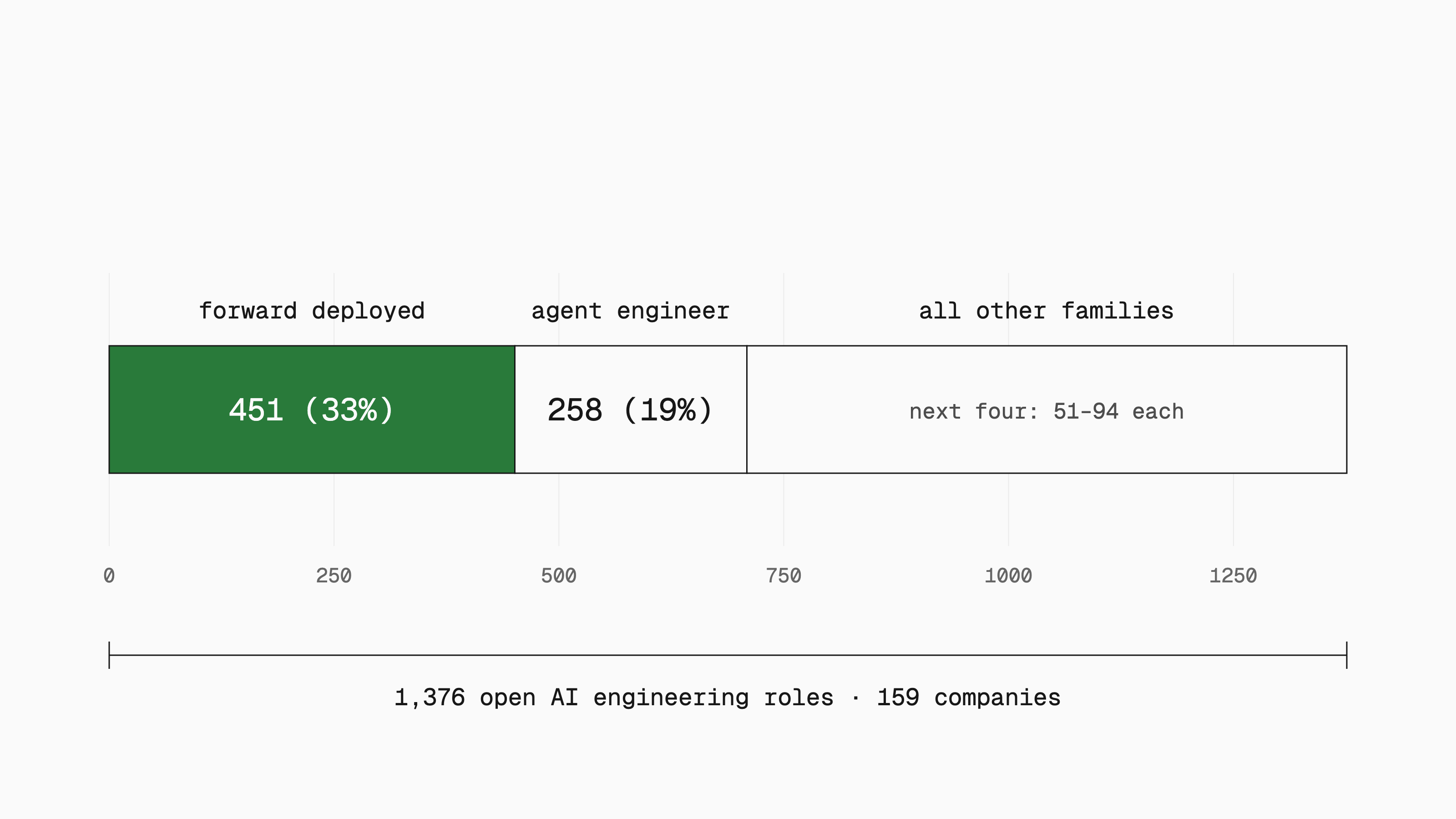
Since the beginning of October, we’ve analyzed 1,376 open AI engineering roles across 159 AI companies.
One trend stands out immediately: forward deployed engineering has become the largest category in the market.
We found 451 open forward deployed roles across 77 companies—roughly one in three AI engineering jobs in our dataset, and comfortably ahead of the next-largest category.
Our dataset isn’t exhaustive, but it spans a broad range of AI companies and industries, giving us a useful snapshot of where engineering demand is concentrated right now.
So what does the AI engineering job market actually look like, and where is demand heading?
Let’s dive in.
The biggest door into AI engineering
Forward deployed engineering has 451 open roles (33%), and Agent engineer comes second with 258 (19%).
The next four families are AI platform, dev tools / infra, research engineer and applied AI, with between 51 and 94 roles each.
The title varies from company to company: Forward Deployed Engineer, Deployed Engineer, Applied AI Engineer, Deployment Strategist, Agent Deployment Engineer. The work is the same. You sit with a customer, build the agent on their data and systems, and stay until it runs in production.
The role started at Palantir.
According to The Pragmatic Engineer, Palantir created it in the early 2010s, and until about 2016 it had more forward deployed engineers than "normal" software engineers.
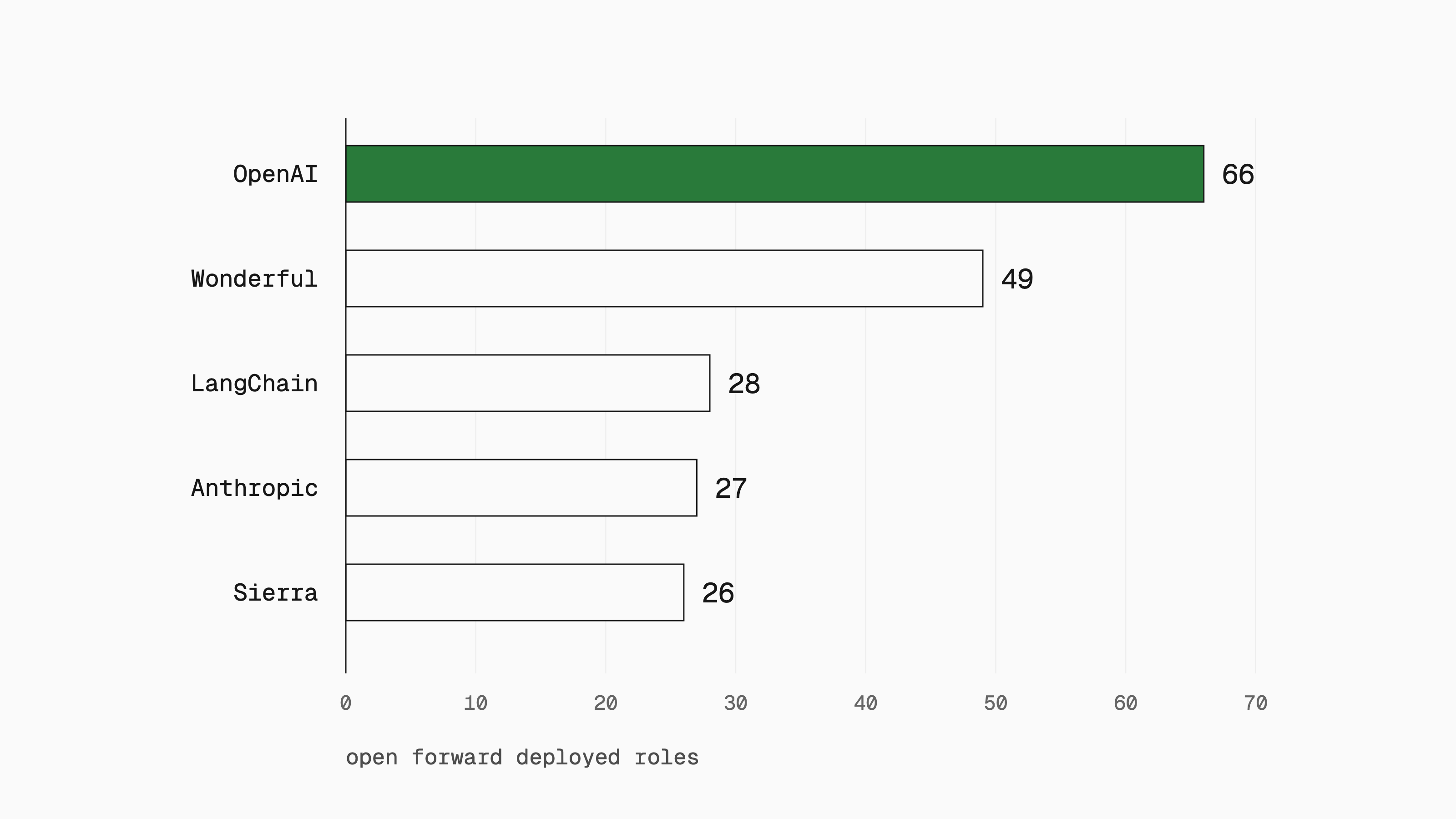
The biggest hirers for this role are OpenAI with 66, Wonderful with 49, LangChain with 28, Anthropic with 27 and Sierra with 26.
What it pays
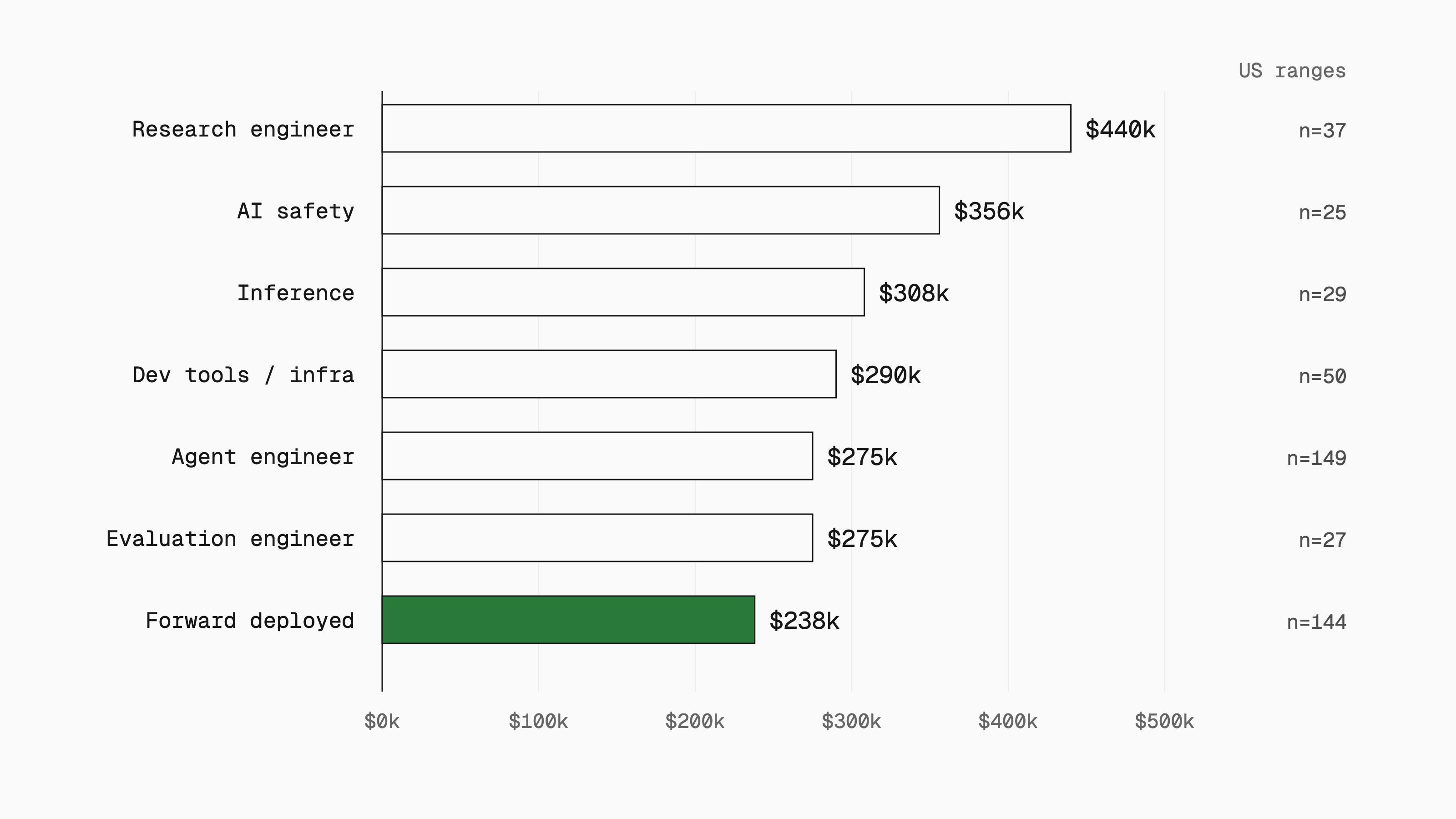
This is the most common AI engineering role, and it has the lowest median posted pay of the 11 role families with at least 20 US pay ranges.
679 roles post a US yearly range.
That's 49% of the total, and many of them are there because state law requires it.
California's SB 1162 has required employers with 15 or more employees to put a pay range in job postings since January 2023. New York State has done the same for employers with four or more employees since September 2023, and Washington requires a wage scale or salary range on postings.
The figures below are the median of the midpoint of each posted US yearly range. They leave out equity and bonus, which at these companies can be a large share of total pay.
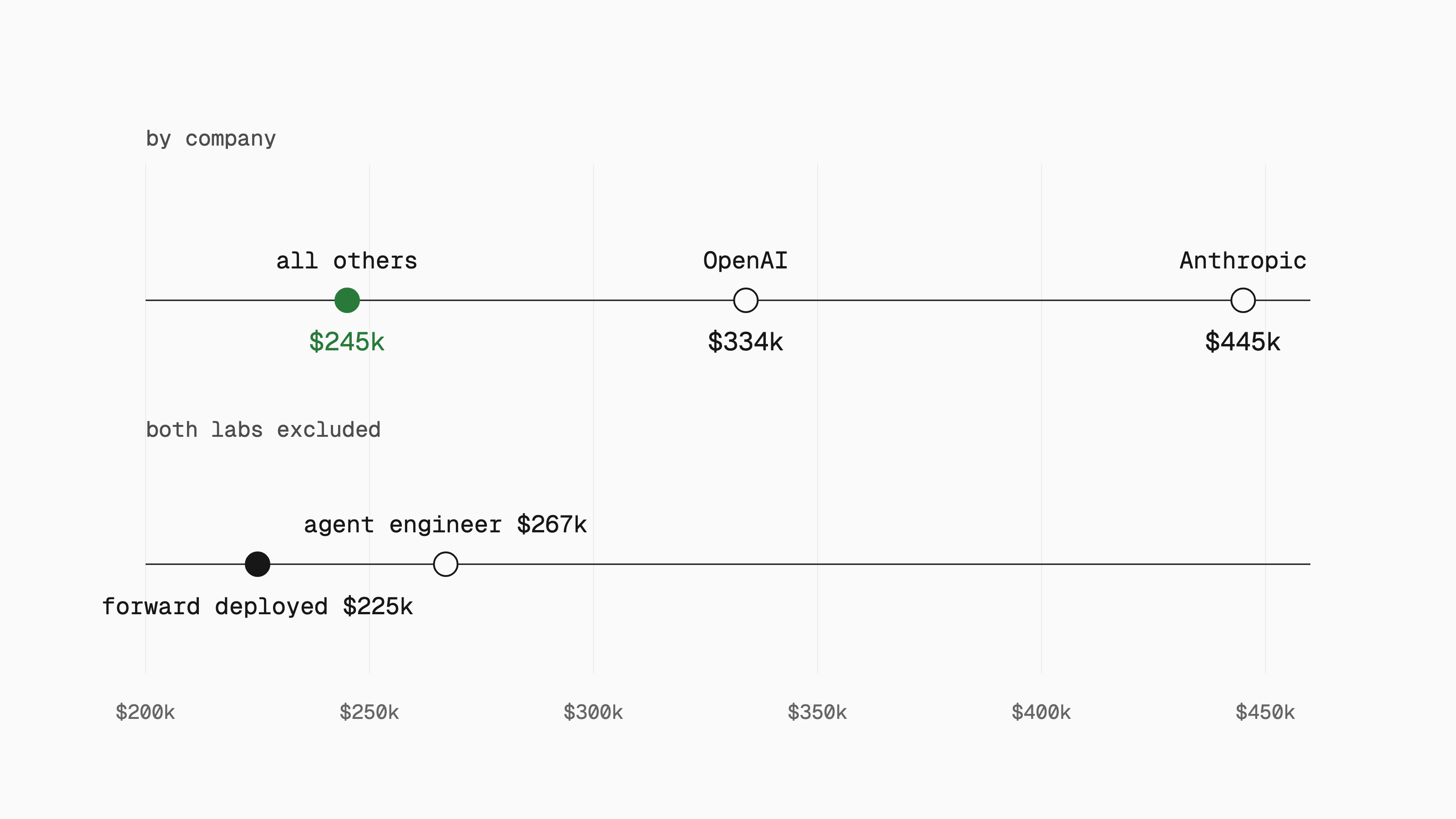
The two big labs raise the top of the scale.
Anthropic's median midpoint is $445k and OpenAI's is $334k, while every other company together sits at $245k. Leave both labs out and the gap is still there: agent engineers at $267k, forward deployed engineers at $225k.
The trade-off: travel
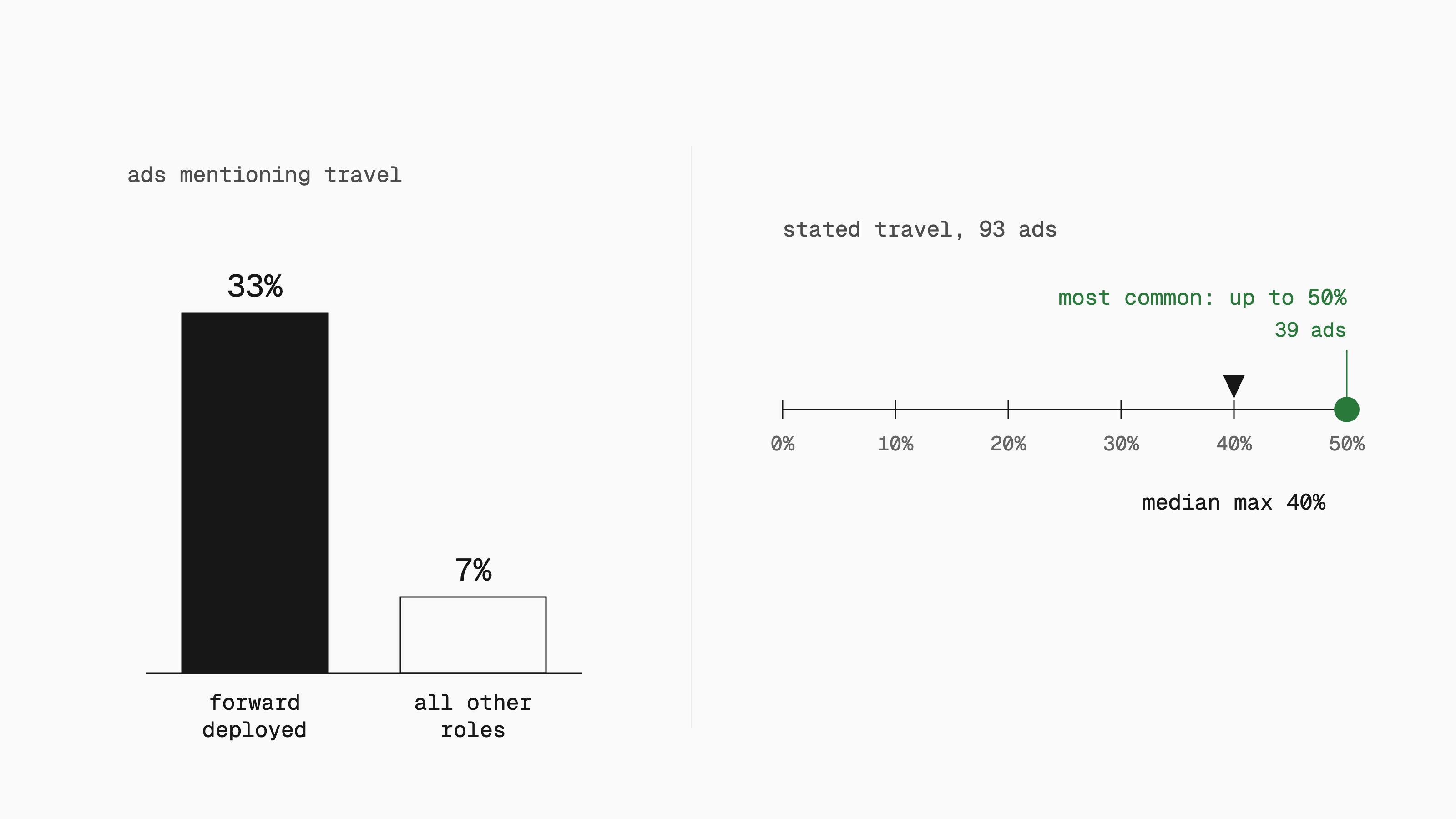
33% of forward deployed ads mention travel.
Across every other AI engineering role, it's 7%. 93 ads say how much travel. The median maximum is 40%, and the most common answer, in 39 ads, is up to 50%. (When an ad gives a range like "25-50%", we count the higher figure.)
The ads put it plainly:
n8n: "open to travelling roughly 30-50% of the time for on-site engagements"
Cognition: "Willingness to travel 25–50%, including frequent travel to India and partner/customer sites"
OpenAI: "Travel up to 50% is required."
Does it fit you? If you like putting things into production in front of a user, can handle a messy client codebase, and can be away from home one or two weeks a month, this is the largest pool of open roles you'll find. If you want deep, long-running ownership of one system, or travel doesn't work for you right now, agent engineer is the next-largest family and its median posted pay is higher. Our walkthrough of the forward deployed and applied AI interview loop covers each round if you decide to go for it.
What the ads actually ask for
Experience counts far more than degrees
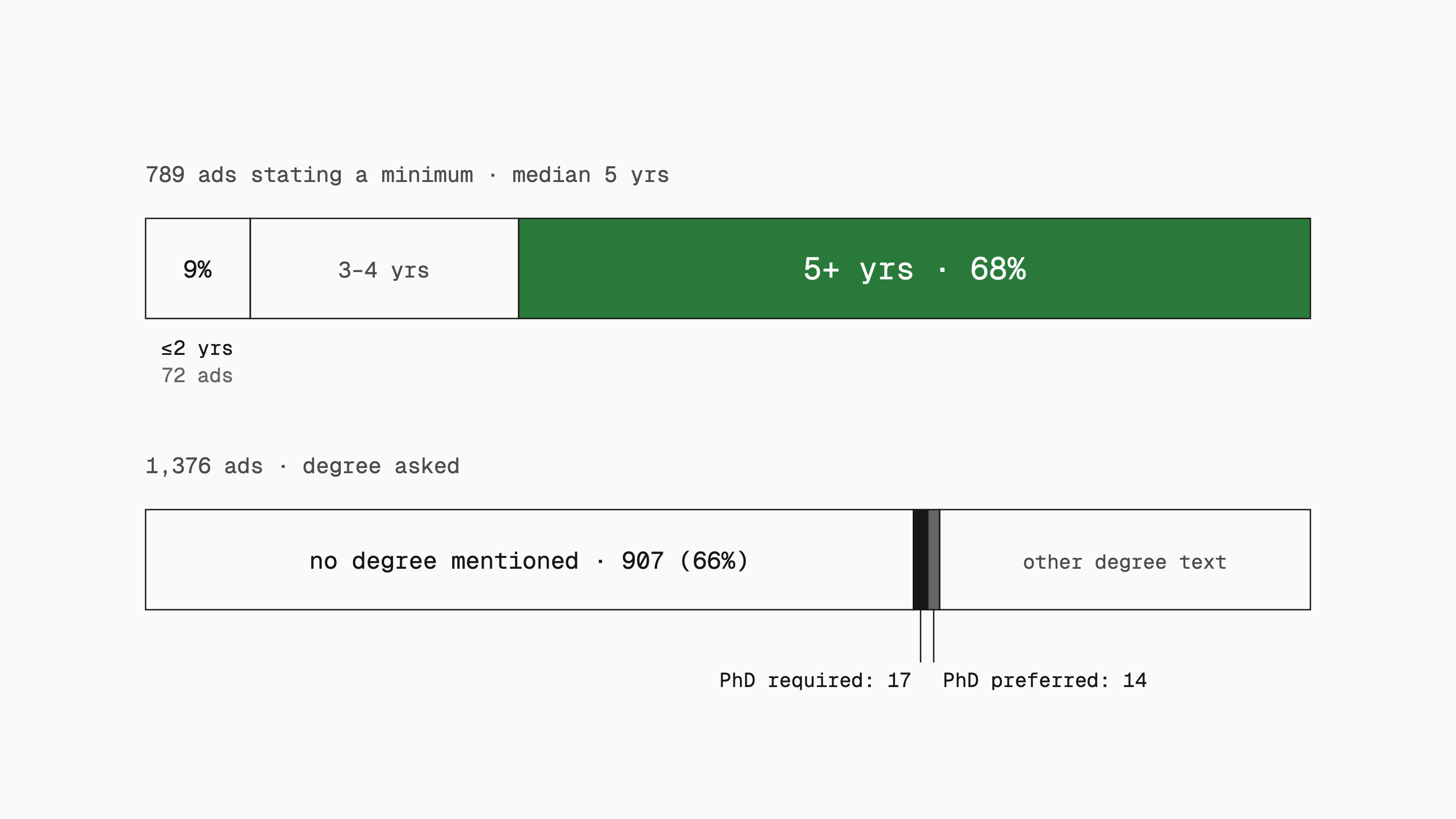
17 of 1,376 roles require a PhD, and 14 more prefer one. 907 ads (66%) don't mention a degree at all.
Years of experience is where the bar sits.
789 ads state a minimum. The median is 5 years, 68% ask for 5 or more, and 72 (9%) accept two years or fewer. Only 25 roles have intern, new grad, early career or junior in the title.
What to do: treat your shipping history as your main credential. If you have fewer than five years, apply to the roles that ask for fewer, and in the rest of your application lead with production work you can show.
Evaluation is part of building agents
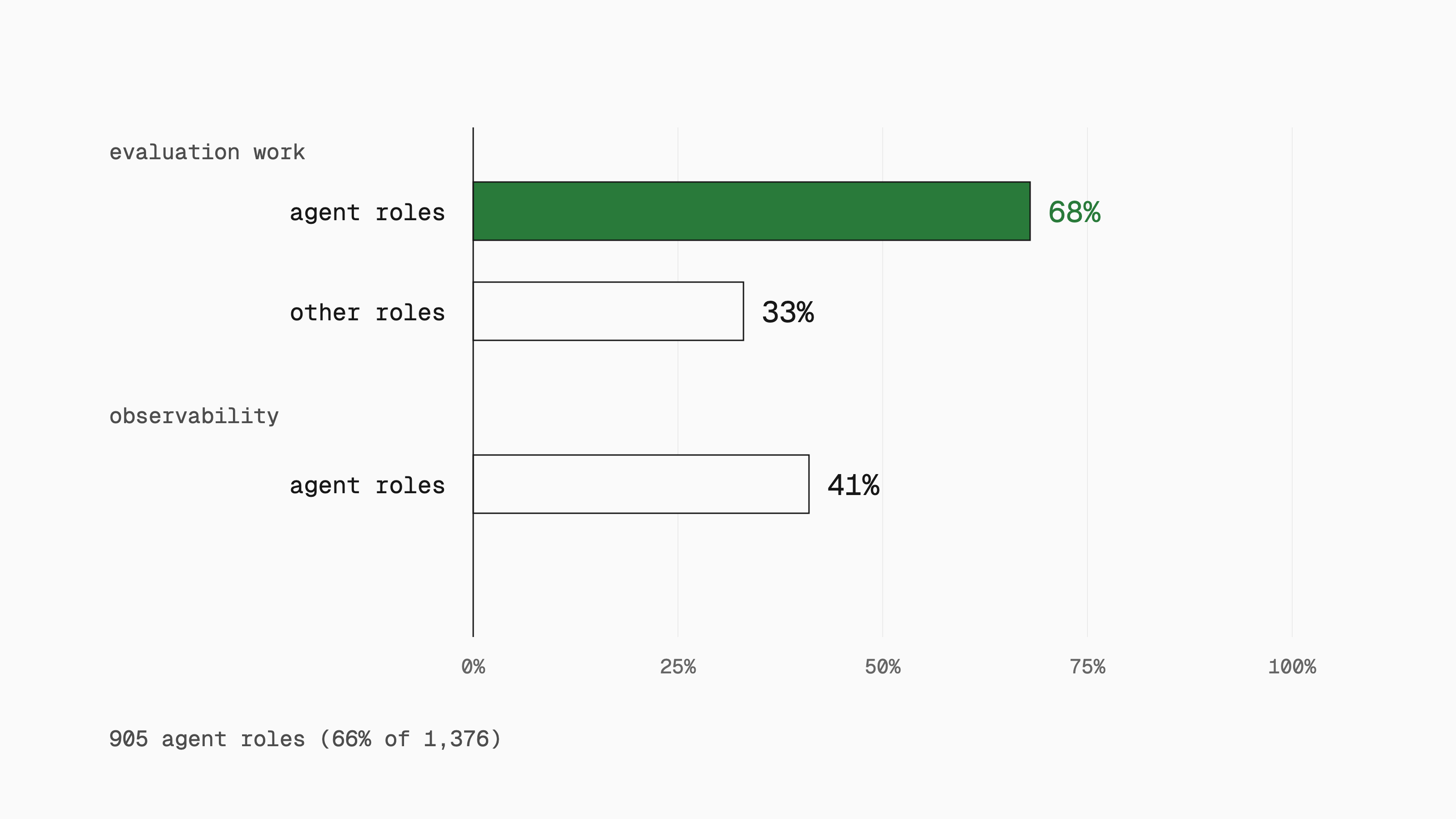
905 roles (66%) involve building agents. 68% of those also involve evaluation work, compared with 33% of other roles. 41% of agent roles involve observability: traces, monitoring, and knowing what the agent did and why.
Evaluation is also a job title now.
There are 48 open evaluation engineer roles, with a median posted pay of $275k across the 27 that post a US range (posted ranges only, no equity or bonus).
What to do: expect an interview question about how you know your agent works, and have a real answer: a test set, a scoring method, and traces you looked at. Our guide to the feedback, verification and measurement layer around the model is a good place to start if your agents don't have this yet.
Fundamentals over frameworks
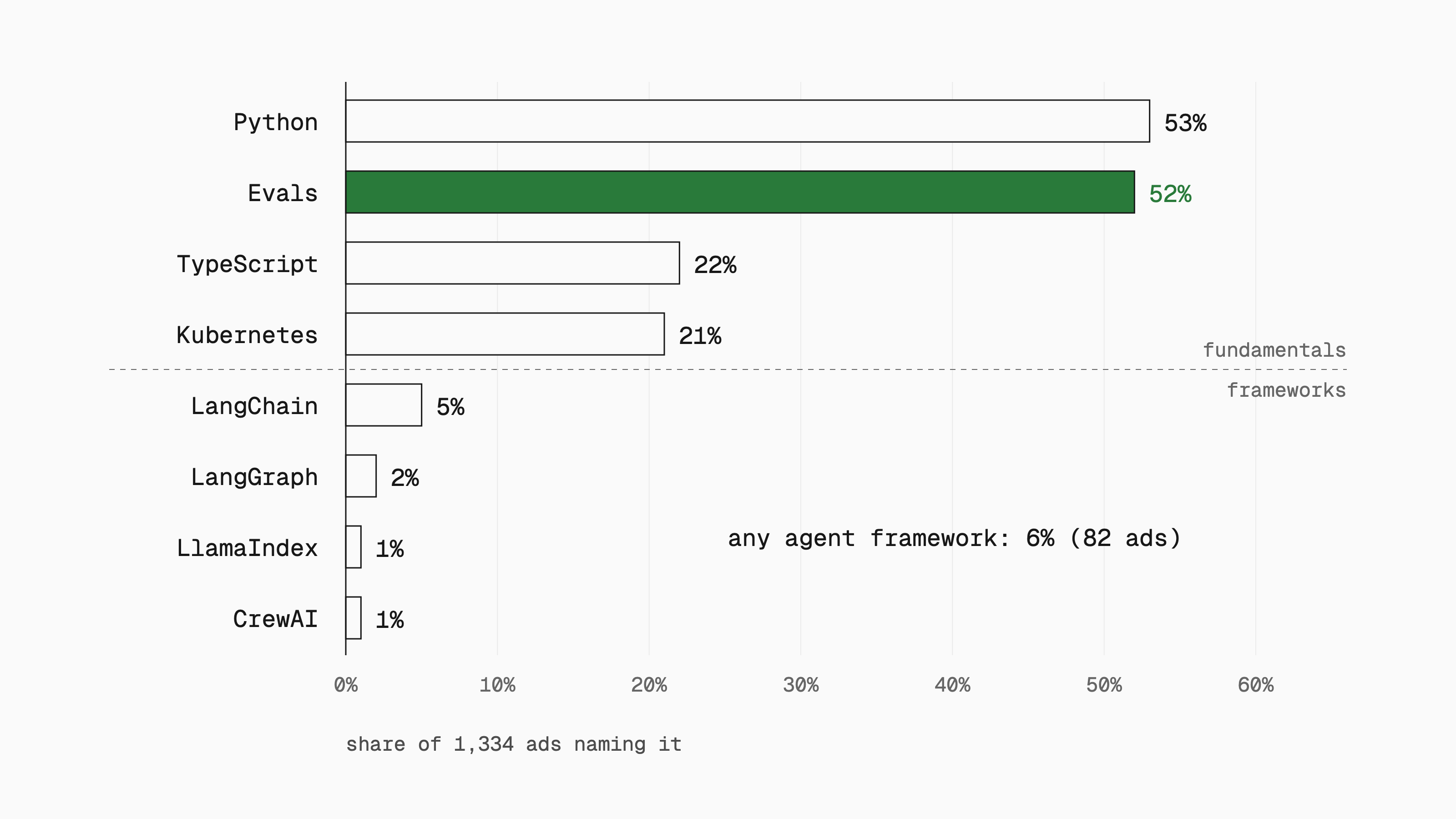
We searched 1,334 ads for the tools they name. LangChain's own 42 openings were left out so they wouldn't skew the framework count. A mention anywhere in the ad counts, "nice to have" included.
Named in the ad
Share of 1,334 ads
Python
53%
Evals
52%
TypeScript
22%
Kubernetes
21%
LangChain
5%
LangGraph
2%
LlamaIndex
1%
CrewAI
1%
82 ads (6%) name any agent framework at all. The companies naming LangChain most often are Databricks (13 ads) and Mistral (9).
Employers describe the work itself: evaluation, retrieval, tool use, production systems. Which framework you use for it rarely makes the ad.
What to do: if you have a framework on your CV, describe what you built with it, how you measured it and how it ran in production. Put the framework name second.
TypeScript for agent products
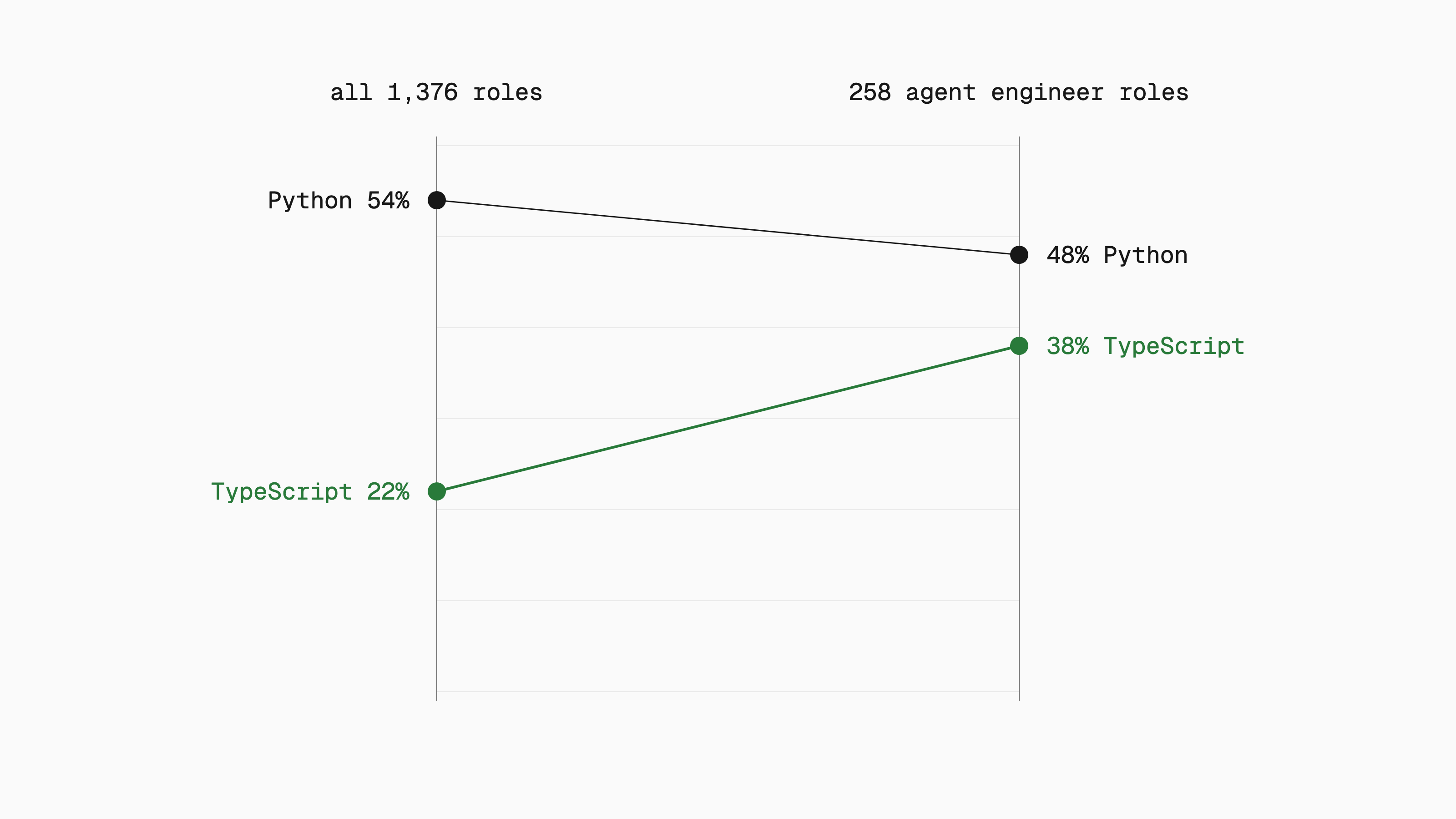
Across all 1,376 roles, 54% of ads name Python and 22% name TypeScript. (This base includes LangChain's ads, so the Python figure differs slightly from the table.) Among the 258 agent engineer roles, it's 48% Python and 38% TypeScript.
Agent engineers build the product around the model: the app, the tool integrations, the interface the customer sees. A lot of that is written in TypeScript, and the ads reflect it.
What to do: if you only work in Python, get comfortable enough in TypeScript to build and ship the front end of an agent. Agent engineer ads ask for it more often than any other family's.
MCP
Anthropic open-sourced the Model Context Protocol on 25 November 2024. It's a standard for connecting AI assistants to the systems where data lives. 115 ads at 45 companies now name it, and 104 of those ads are outside Anthropic.
Across the same 1,376 ads, RAG appears in 14%, reinforcement learning in 11%, fine-tuning in 10%, MCP in 8% and vector databases in 7%. A protocol less than two years old shows up about as often as vector databases.
What to do: build at least one MCP server yourself, so you can talk about tool design, auth and failure handling from experience.
Coding agents as a stated skill
57 ads at 37 companies ask for hands-on experience with Claude Code, Cursor, Codex or coding agents. We only counted companies that don't make coding tools themselves (1,047 ads), which leaves out Anthropic, OpenAI, Cursor, Cognition, Replit, Factory, Sourcegraph and Warp.
That's 5% of those ads.
Cerebras: "Demonstrated adoption of AI in your engineering workflow: active use of coding agents, a view on where they help and where they mislead, and the rigor to verify what they produce."
Patronus AI: "Be a power user of AI coding tools like Claude Code, Codex, Cursor, and similar tools"
Addepar: "Experience with AI-assisted development tools (Claude Code, Codex, or similar)"
What to do: the Cerebras wording describes the skill well. Use the agent, then check what it produced. Be ready to explain how you do that check.
Comfort with ambiguity
After communication, the soft skill the ads name most is comfort with ambiguity. It appears in 582 ads at 97 companies (42%).
This counts the word anywhere in the ad, company boilerplate included.
Named in the ad
Share
Communication
64%
Ambiguity
42%
Curiosity
13%
Fast-paced
11%
Taste
8%
High agency
8%
Scale AI wants engineers who "translate ambiguous customer problems into scalable production AI architectures." OpenAI asks for a record of leading AI systems "from ambiguous discovery through production deployment."
What to do: prepare one story about a vague request you turned into something that shipped. Cover what you asked, what you decided, and what you cut.
Where the jobs are, and what remote means
Open roles by metro:
SF Bay Area: 629
New York: 332
London: 166
Seattle: 84
Washington DC: 51
Toronto: 38
A role that lists several cities counts in each one, so these figures add up to more than the total. The Bay Area and New York together hold 54% of the 1,344 roles that state a place. London is third, with twice as many openings as Seattle. By country, the US has 64% and Europe, including the UK, has 21%.
Check what remote covers
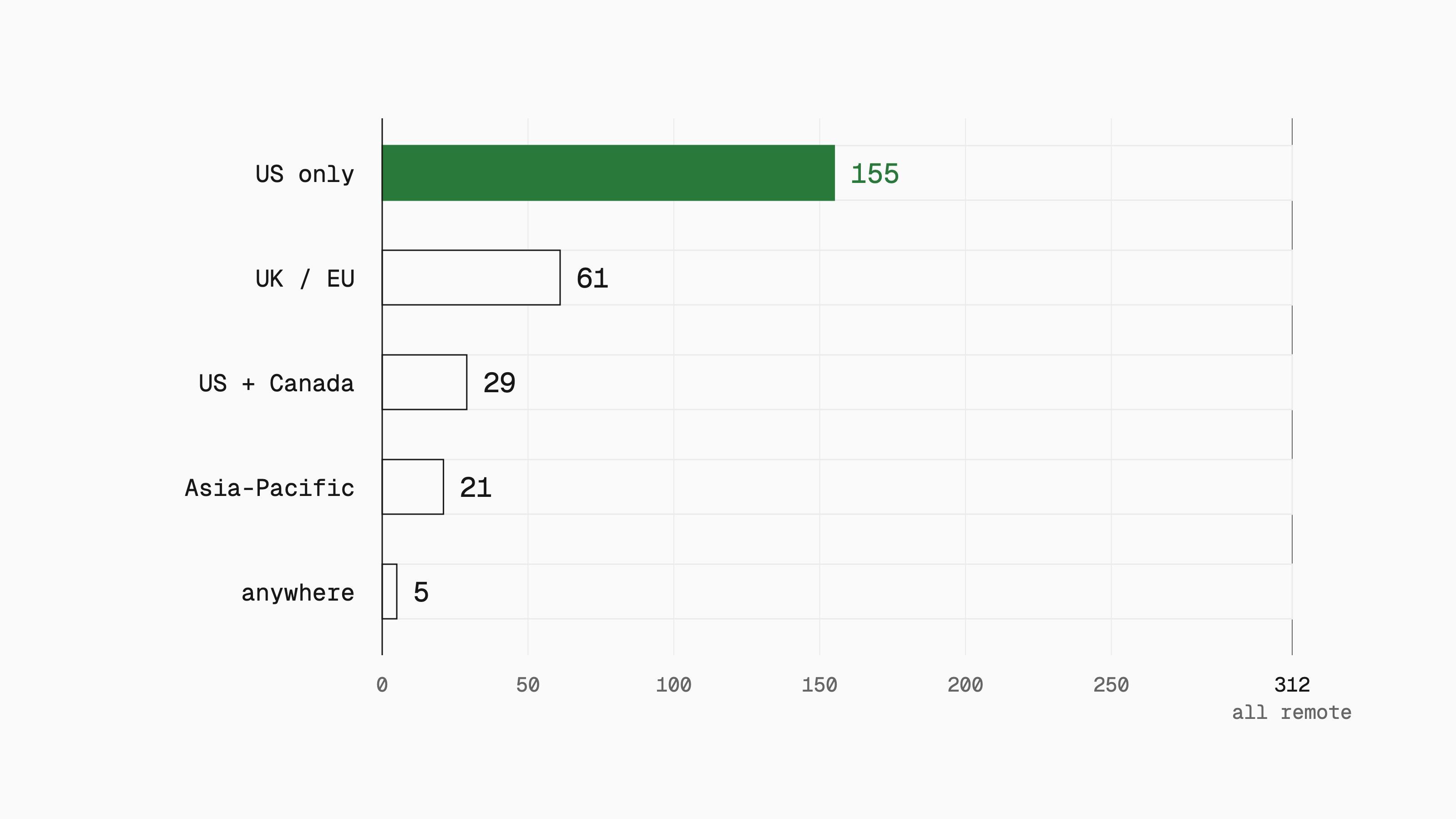
312 roles are listed as remote. 5 of them accept applicants from anywhere. 155 remote roles are US only, 61 are limited to the UK or EU, 29 to the US and Canada, and 21 to Asia-Pacific.
We took these from each posting's own location and eligibility text.
Remote is also the smaller share. Of the 1,100 roles that state a work mode, 47% are on-site, 24% hybrid and 28% remote. Anthropic lists none of its 112 roles as remote. OpenAI lists 29 of its 141.
If you live outside the US, read the eligibility line before anything else in the ad.
Who is hiring
OpenAI leads with 141 open roles, then Anthropic with 112. After them come Sierra (67), Wonderful (50) and Decagon (47). All three sell AI agents for customer service, and together they have 164 open AI engineering roles. Databricks (44), LangChain (42) and Scale AI (42) together have 128.
Much of that hiring is forward deployed: 26 of Sierra's 67 roles, 49 of Wonderful's 50 and 21 of Decagon's 47. These companies hire engineers to put agents in front of their customers' customers.
For a job seeker, this shows where agents are running in production today. In our data, customer service is the agent use case with the most hiring behind it. If you've built anything for support workflows, such as ticket routing, retrieval over help center content, or handoff to a human, put it near the top of your CV.
A 30-day plan built from the data
Each step ties back to a finding above.
Week 1: build one agent with an evaluation suite and traces. Choose a narrow task, write 30 to 50 test cases, score the outputs and keep the traces. This answers the question 68% of agent roles will ask you in some form (Finding 07).
Week 2: expose one of its tools as an MCP server. Write down the tool schema decisions and what happens when a call fails (Finding 09).
Week 2: build its interface in TypeScript. A small web front end is enough. It matches what 38% of agent engineer ads name (Finding 08).
Week 3: write down how you check what a coding agent produced. One page covering when you trust its output, what you review line by line, and what you test. Cerebras asks for exactly this kind of rigor (Finding 12).
Week 3: rewrite your CV around shipped work and measurement. Put years of production experience and evaluation results first and framework names second (Findings 04 and 06).
Week 4: prepare your ambiguity story. One vague request, the questions you asked, and the system that shipped. 42% of ads will give you an opening to tell it (Finding 13).
Before every application: check the remote eligibility, and for forward deployed roles, ask about travel in the first call. 155 of 312 remote roles are US only, and the most common stated travel figure for forward deployed roles is up to 50% (Findings 05 and 03).
By the end of the month you'll have one project that covers evaluation, tracing, MCP and a TypeScript interface, plus written answers to the questions these ads keep raising.
Browse the roles
Every role in this report is listed on the agentnative.dev AI engineering jobs board. It's free to browse, and you can filter by role family, seniority and remote mode, so you can go straight to forward deployed, agent engineer or evaluation roles in the countries you can work from.