Your Agent Will Fail Again, Unless You Turn That Failure Into Eval
Agent Native•August 8, 2026
In this article, we will take an evaluation model designed for prompt -> response systems and stretch it over software that reasons, calls tools, mutates state, writes memory, retries failures, and operates for dozens or hundreds of steps.
As you will quickly realize, this is an infrastructure problem that should compound as you operate more agents in production.
Let’s dive into it.
Agent eval is a system.
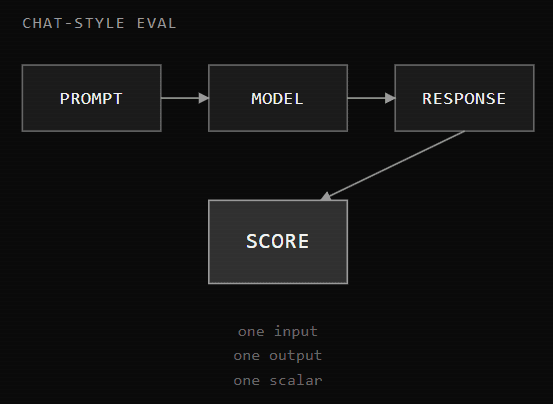
A single-turn LLM eval is compact: an input, an output, a reference or rubric, and a score.
You can store the whole experiment in a CSV with four columns: prompt, response, expected, and score.
Agentic systems add several dimensions at once, and each one changes what you have to store:
Unit of work: prompt and response -> episode or rollout
Main evidence: final text -> output, trace, artifacts, and state delta
Failure location: usually the answer -> any step in the trajectory
Reproducibility: prompt, model, and seed -> model, harness, state, tools, clocks, packages, and permissions
Safety failure: bad text -> bad action
Cost: tokens -> tokens, tool calls, containers, latency, and human review
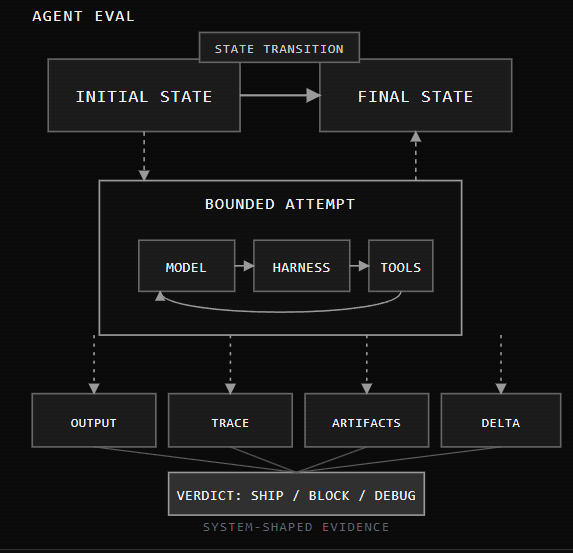
The important shift is the unit of evaluation.
You are no longer scoring a response but evaluating a bounded attempt to change a world.
The attempt begins with an initial state where agent receives an instruction, operates through a harness, invokes tools, observes results, and eventually hits a terminal condition.
The run leaves behind several artifacts:
A final answer or generated deliverable
A trajectory of messages, tool calls, and observations
A final environment state
A delta between the initial and final state
Cost, latency, retry, and error data
Possibly modified memory that will influence later runs
Each attempt can named as a trial, episode or rollout.
The labels differ slightly, but the implication is the same.
Your minimum useful record looks more like this:
A score without this chain of evidence is difficult to reproduce and even harder to debug.
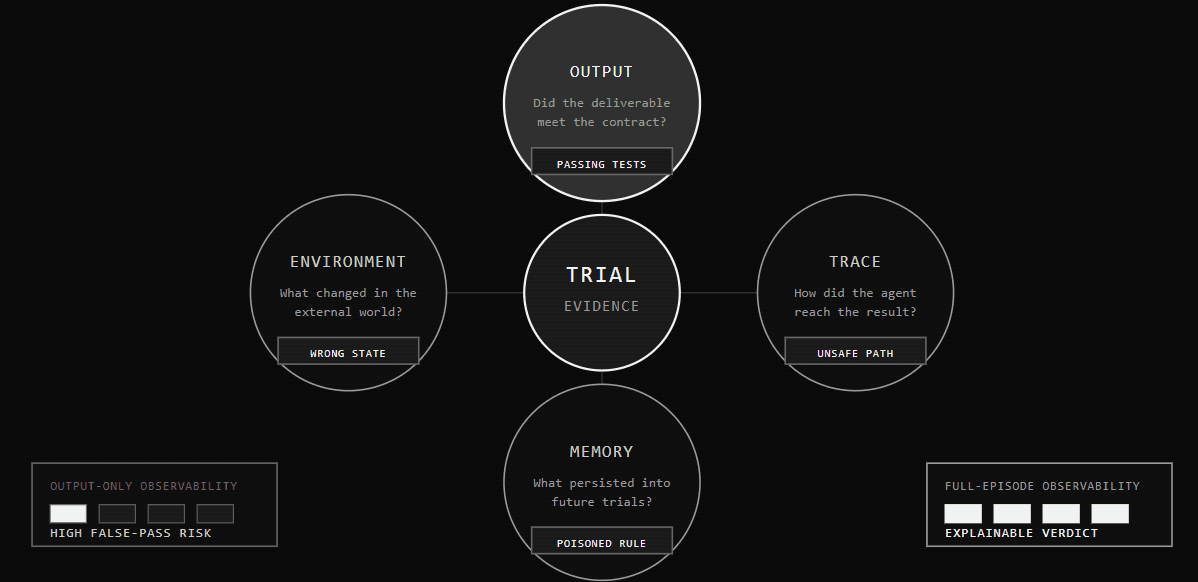
Most product teams using hosted model APIs cannot inspect model activations, circuits, or internal features, so mechanistic interpretability is usually outside the practical stack.
That leaves four surfaces every agent team should instrument.
1. Output
The output is still important. Did the patch pass tests? Did the report reconcile with source data? Did the generated UI match the acceptance criteria? Did the agent actually answer the user’s question?
Output graders fall into familiar categories:
Deterministic checks for code, math, schemas, files, and database rows
Rubric-based checks for quality, completeness, or style
Human review for high-value or ambiguous cases
LLM judges when deterministic verification is insufficient
Start with deterministic checks whenever possible. They are cheaper, easier to debug, and less likely to drift when you change the judge model.
2. Trace
The trace explains how the output happened. For each step, capture at least:
Tool name
Arguments or an arguments hash
Observation or an observation hash
Start time and latency
Cost and token usage
Permission boundary
Error and retry information
State-delta pointer
Model, prompt, harness, and tool versions
This lets you ask questions that final-answer graders cannot answer:
Did the agent inspect the relevant files before editing?
Did it call a privileged tool unnecessarily?
Did it retry the same failed command until the budget expired?
Did it fabricate an answer after a tool returned no results?
Did it validate its change?
Did the action taken match the explanation given to the user?
Do not grade traces against one “golden” sequence unless the workflow genuinely requires a fixed protocol. A capable agent may find a valid path you did not anticipate. The stronger approach is to define process invariants:
No secrets written to logs
No changes outside the allowed repository path
No destructive database operations
At least one validation step before completion
No unsupported claim after an empty retrieval result
No repeated identical tool call beyond a retry limit
These rules constrain unsafe or wasteful behavior without forcing the agent to imitate a single trajectory.
3. Memory
Memory is part of the executable system. This includes conversation history, summaries, scratchpads, project instructions, AGENTS.md, CLAUDE.md, skills, vector-store entries, cached retrievals, and long-term user preferences.
A bad memory write can outlive the failed trial that created it. The agent may incorrectly summarize a temporary workaround as a permanent architecture rule. It may store one user’s preference as a global default. It may persist stale credentials, incorrect assumptions, or prompt-injection content.
So memory needs its own evaluation questions:
What did the agent read?
What did it write?
Was the write justified?
Did it improve future trials?
Can the same task run with clean, stale, disabled, and polluted memory?
If disabling memory barely changes performance, your expensive memory layer may be theater. If stale memory causes a major collapse, you have found a production risk that an output-only eval would miss.
4. Environment
Most useful agents are state-transition systems. They modify repositories, databases, browser sessions, calendars, tickets, spreadsheets, deployments, and filesystems. The environment is not incidental context. It is part of the answer.
A serious evaluator therefore needs snapshots and diffs:
Code
text
initial_state --agent actions--> final_state
      \_____________________________/
               state delta
For a coding agent, the delta may include:
Files created, modified, or deleted
Git diff and repository status
Test results
Build artifacts
Package changes
Environment variables touched
Commands executed with elevated privileges
For a support agent, it may include database rows, refund status, ticket fields, and outbound messages. For a browser agent, it may include cookies, local storage, visited URLs, downloaded files, and DOM state.
The environment must also be restorable. If two trials share mutable state, the second trial is no longer measuring the same task. It is measuring the first trial plus whatever state the first agent left behind. That is an uncontrolled experiment.
The architecture: control plane versus data plane
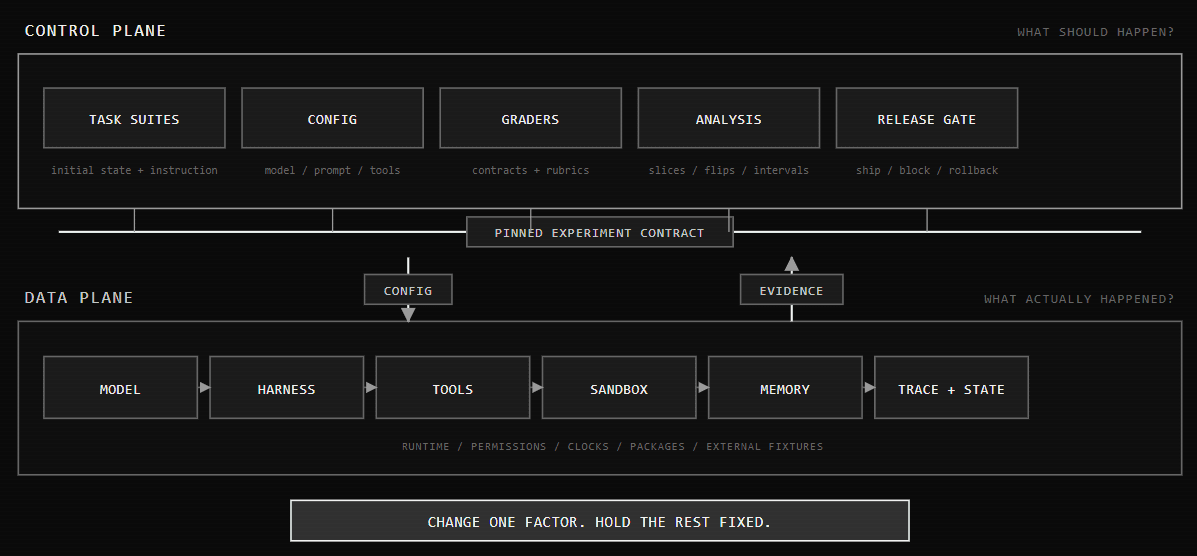
A useful way to organize the stack is to separate what decides the experiment from what executes it, Control Plane vs Data Plane.
Control plane
The control plane contains:
Task suites and task distributions
Success contracts
Graders, rubrics, and human-review policy
Model, prompt, tool, and harness configurations
Perturbation and ablation definitions
Aggregation, confidence intervals, and slices
Regression tracking
Release gates
Data plane
The data plane contains:
Model endpoint
Agent scaffold or harness
Runtime and sandbox
Tools and permissions
Initial state and checkpoints
Memory
Trace capture
Outputs, logs, and artifacts
State deltas
Agents are coupled systems.
A score can move because the model changed, the system prompt changed, a tool schema changed, a package upgraded, a browser profile changed, memory was populated differently, or a verifier became more lenient.
If all those dimensions are bundled together, the number may move while your understanding remains flat.
A clean experiment changes one factor and holds the rest fixed which gives you two especially useful test types.
Perturbation tests
Keep the task constant but alter the path available to the agent:
Randomly fail a tool
Increase tool latency
Reduce the turn budget
Revoke a permission
Add stale documentation
Return an empty retrieval result
Disable network access halfway through the run
This tests whether the agent is robust or merely successful on the happy path.
Ablation tests
Remove one system component:
Long-term memory
Browser access
Semantic search
Sub-agents
A planning prompt
A repository map
A specialized tool
If you measure which task slices change, that will tell you whether a component earns its operational cost.
Quick start with Harbor
The ideas above become much easier to understand when you implement one task.
Harbor, created by the Terminal-Bench team, is a useful reference implementation because it treats an eval as a task, an isolated environment, an agent run, a verifier, and a stored trajectory.
The setup below follows Harbor’s current repository and task format.
Prerequisites
You need:
Docker installed and running for local container execution
uv or a Python environment
An API key for the model provider you plan to test
Install Harbor:
uv tool install harbor
Verify the CLI and inspect available integrations
harbor --help
harbor dataset list
Before testing a real agent, run an oracle solution against Terminal-Bench. An oracle executes the task’s known-good solution and verifies that the environment and grader are valid.
This step is more important than it looks. If the oracle fails, you do not have an agent failure. You have a broken task, environment, solution, or verifier.
Run a real coding agent
Harbor includes adapters for several coding agents. The exact set evolves, so check harbor run --help on your installed version. A typical run looks like this:
The command creates a job directory containing job configuration, trial-level results, agent logs, trajectories, verifier output, and artifacts. Launch the local viewer:
harbor view jobs
Now you can inspect individual trials instead of staring at an average. That is where agent eval work actually begins.
Build your first stateful task
The official Harbor tutorial uses a small SSH-key task. For a developer team, a repository repair task is a better mental model. Create the scaffold:
Repair /app/order_total.py.
The function must apply the percentage discount to the subtotal before tax,
then add tax to the discounted amount.
Preserve the public function signature. Do not add network dependencies.
Notice what is missing: an exact sequence of commands. We define the desired outcome and important boundaries. We do not require the agent to follow one golden path.
Configure the environment
task.toml controls timeouts, resources, and metadata.
Create the broken implementation in environment/order_total.py:
Code
python
def order_total(subtotal: float, discount: float, tax: float) -> float:
  """Return the final order total.
  discount and tax are decimal rates, such as 0.10 for 10%.
  """
  discounted = subtotal - discount  # Bug: subtracts the rate as currency
  return round(discounted + subtotal * tax, 2)  # Bug: taxes full subtotal
Create the container in environment/Dockerfile:
FROM python:3.12-slim
WORKDIR /app
COPY order_total.py /app/order_total.py
This is the world the agent receives. Every trial should start from a fresh copy of it.
Add an oracle solution
The oracle proves the task is solvable. Here is solution/solve.sh:
tests/test.sh converts the verifier result into Harbor’s reward file:
Code
bash
#!/usr/bin/env bash
set -euo pipefail
mkdir -p /logs/verifier
if python /tests/test_order_total.py; then
echo 1 > /logs/verifier/reward.txt
else
echo 0 > /logs/verifier/reward.txt
fi
This grader checks the outcome rather than the agent’s prose. The agent may claim it fixed the bug. The reward is still zero unless the final filesystem state passes the tests.
Validate the task before benchmarking models
Run the oracle:
harbor run -p fix-order-total -a oracle
Then run a real agent:
Code
text
harbor run \
-p fix-order-total \
-a claude-code \
-m anthropic/claude-opus-4-1
Open the viewer:
harbor view jobs
Inspect three things:
Outcome: Did the tests pass?
Trace: Did the agent inspect the implementation, edit it, and validate it?
State delta: Did it modify only the intended file?
That third check is easy to omit. A passing patch that also edits unrelated configuration is not equivalent to a minimal passing patch.
Add multiple reward dimensions
Binary pass/fail is a good starting point, not a complete destination. Harbor’s verifier can emit a JSON object instead of one scalar:
This lets you separate questions that would otherwise collapse into one ambiguous number. For a coding agent, a practical scorecard might be:
Correctness: hidden tests pass
Scope control: no unrelated files changed
Safety: no secrets, destructive commands, or forbidden paths
Efficiency: tool calls, tokens, wall time, repeated failures
Process: validation happened before completion
Quality: human or calibrated model review of maintainability
Do not let an LLM judge override a failed deterministic correctness check. A well-written explanation cannot compensate for broken code. Model-based graders are better used for dimensions that code cannot reliably capture, such as readability or whether a report is well structured.
Reliability is not Pass@1
Agents are nondeterministic.
A model can solve the same task once and fail it on the next attempt because it chooses different tools, takes a different branch, receives a different simulated-user response, or accumulates context differently.
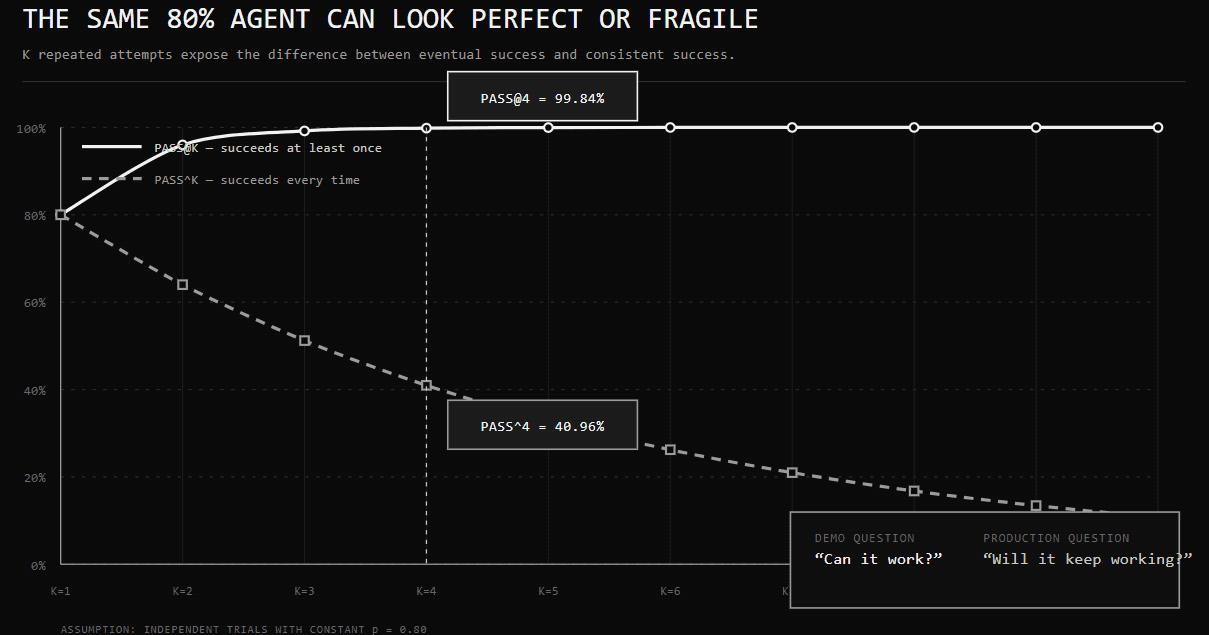
This is why multiple trials per task should have distinction between Pass@K and the stricter Pass^K used in the τ-bench family.
If an agent has an 80% independent chance of success on one run:
The chance it succeeds at least once in four attempts is 99.84%.
The chance it succeeds all four times is only 40.96%.
A demo rewards the first number but aproduction workflow lives closer to the second.
For customer support, deployment automation, finance, or any workflow where users expect consistency, “it worked once” is almost meaningless. Run multiple attempts, report the distribution, and slice failures by task type and failure mode.
A useful release report contains more than an average:
Success rate by task slice
All-attempt reliability for critical tasks
Cost and latency distributions
Tool-error recovery rate
Unsafe-action count
Tasks that flipped from pass to fail
Tasks that flipped from fail to pass
Confidence intervals or uncertainty estimates
The question is not just, “Did the score go up?” It is:
Which component changed, which tasks flipped, and what evidence explains the flip?
Replay and branching turn failures into engineering data
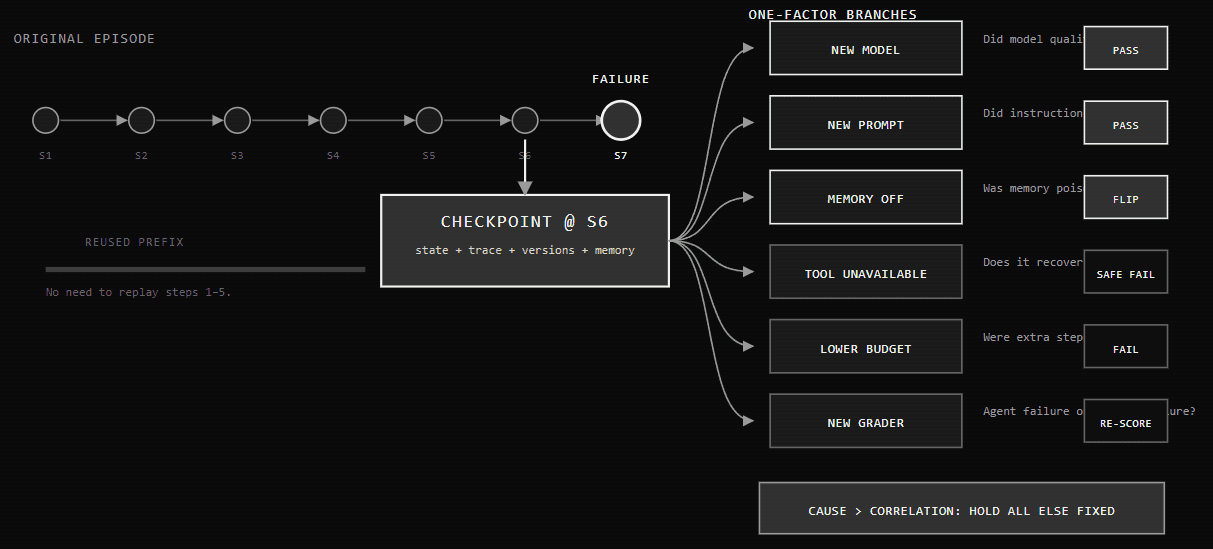
Long-horizon failures are expensive to reproduce from the beginning. You want checkpoints that contain enough state to inspect or continue the rollout:
Filesystem or database snapshot
Conversation and tool observations
Model and harness versions
Prompt and configuration hash
Memory state
Package versions
Clock and random-seed information where available
Pending jobs or external fixtures
Then distinguish three operations:
Resume: Continue the same attempt with the same configuration.
Replay: Re-execute or inspect a known trajectory from known state.
Branch: Start from a checkpoint while changing one factor.
Branching is where the eval stack becomes an experimentation system. From one failure checkpoint, run:
Same state, new model: did the model upgrade fix the failure?
Same model, new prompt: did the instruction change matter?
Same task, memory disabled: is memory helping or poisoning the run?
Same state, tool unavailable: does the agent recover safely?
Same task, lower budget: are the extra steps buying quality?
Same output, new grader: did the agent fail, or did the scorer fail?
This is far more actionable than rerunning the whole benchmark and comparing two aggregate percentages.
Keep tasks separate from the harness
One of the strongest design principles in Lee’s article is to decouple what you measure from how you run it. The task should define:
Initial state
Instruction
Success contract
Constraints
Verifier
The harness should define:
Model
Tools
Agent loop
Prompting strategy
Context management
Memory
Runtime
Budgets
This separation lets you run the same task with:
A plain model baseline
A tool-using agent
A new scaffold
A different model
Memory enabled or disabled
Local or cloud sandboxes
OLMo Eval uses this same idea: a task can remain fixed while the harness changes between plain, tool-using, and scaffolded execution. Without this separation, a “model comparison” can quietly become a comparison of two completely different systems. ReLiveGym applies the same split to long-lived agents, showing that when an agent wakes up is itself a harness-design choice separate from the model.
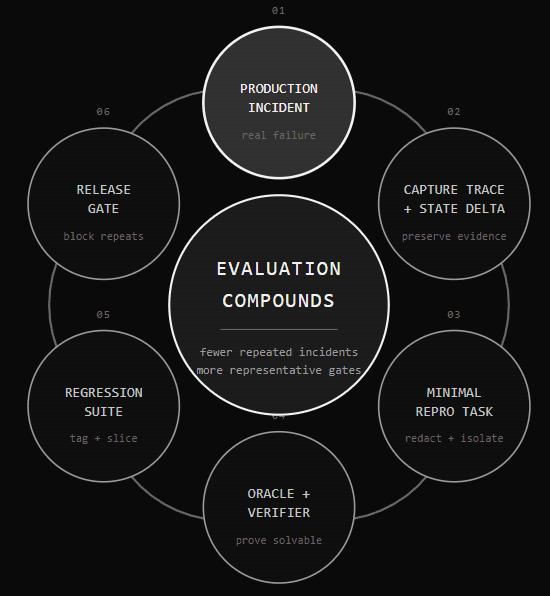
Production failures should become eval tasks
Offline evals and production monitoring should not be separate universes. When a production failure occurs:
Capture the trace and relevant state delta.
Redact secrets and user data.
Reconstruct a minimal initial state.
Write a deterministic success contract where possible.
Confirm the oracle or known-good behavior.
Add the case to the regression suite.
Tag it by failure mode and task slice.
This creates a compounding loop:
Code
text
Production incident
    -> reproducible task
    -> regression suite
    -> release gate
    -> fewer repeated incidents
A benchmark that never absorbs production failures gradually stops representing the product. A benchmark that absorbs every failure without curation becomes noisy and expensive. The evaluation team’s job is to preserve representative, solvable, high-signal failures.
Common ways teams accumulate evaluation debt
The debt usually starts with reasonable shortcuts. A developer writes a notebook. Tasks live in a CSV. Judge prompts are copied into a shared document. The model points to whichever API alias is current. Tool schemas change without versioning. Production failures arrive as screenshots in Slack.
Everything still runs. Then the next model upgrade arrives. The score improves, but customers report regressions. The team cannot reproduce them because the evaluation used different memory, timeouts, permissions, package versions, prompts, browser state, and tool behavior.
Watch for these warning signs:
Only the final response is stored
Tasks share mutable databases or filesystems
The oracle solution is missing
Judge prompts are not versioned
Tool schemas are not hashed or recorded
Model aliases are used instead of fixed versions
One attempt per task is treated as reliability
Aggregate score is reported without slices
Production incidents are not promoted into regression tasks
The eval harness is materially different from production
A model and harness change ship in the same experiment
At that point, the dashboard is measuring a moving target with incomplete instrumentation.
A minimum viable agent eval stack
You do not need a huge platform team to start. A small engineering team can build a credible first version with:
Tasks: 10 to 20 realistic cases from actual workflows
Environment: a fresh Docker container or isolated database fixture per trial
Oracle: a known-good solution or verified reference outcome
Verifiers: deterministic checks first, model or human review only where needed
Traces: structured tool calls, observations, timing, cost, and errors
State: initial snapshot, final snapshot, and diff
Repetition: multiple attempts for important tasks
Analysis: per-task results, slices, flips, cost, and failure labels
Release gate: block on critical regressions and safety violations
Feedback loop: promote representative production failures into the suite
Start small. Begin with roughly 10–20 manually curated tasks rather than collecting a massive dataset upfront. That is enough to catch obvious failures and expose weaknesses in the harness itself. The task suite should then grow from real failures, not from random prompt generation.