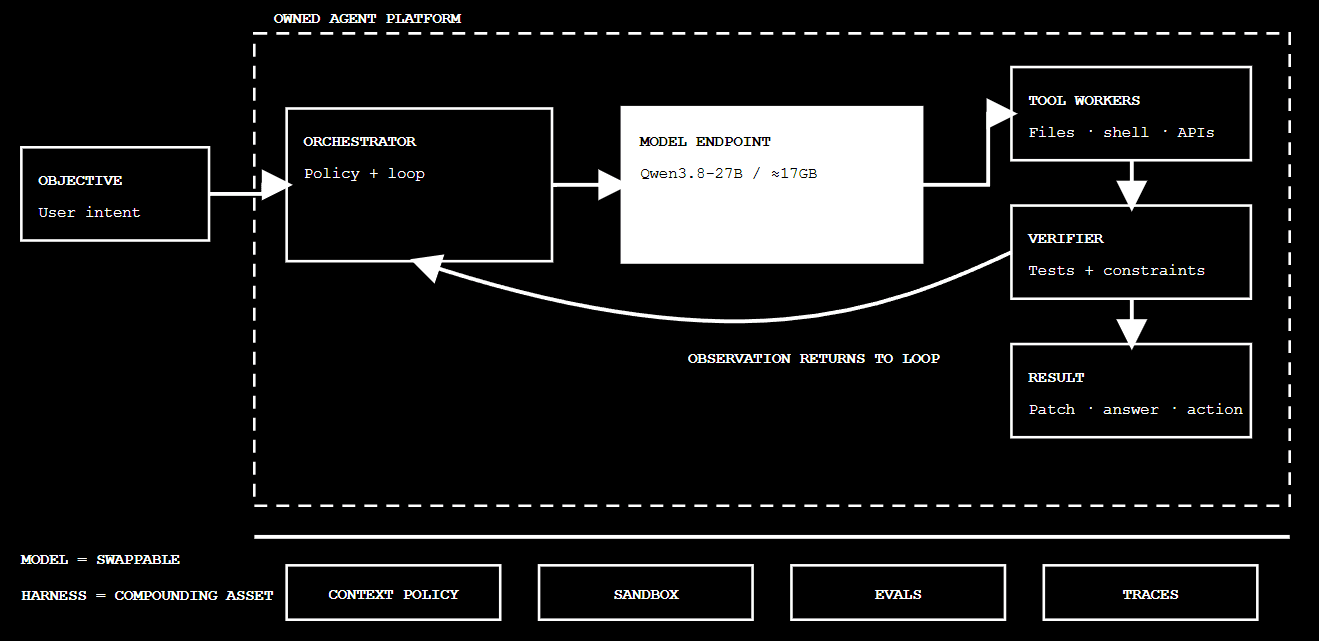
Qwen3.8–27B will run locally on systems with roughly 17GB of VRAM.
That sounds like an RTX 4090-class coding agent with near-frontier capabilities.
But 17GB does not mean the full model will occupy exactly 17GB under production load and it certainly refers to a quantized build, not the original weights.
It does not include the complete KV cache, concurrent agent sessions, CUDA graphs, runtime buffers, multimodal components, or the memory consumed when an agent drags a large repository and ten rounds of tool output through its context window.
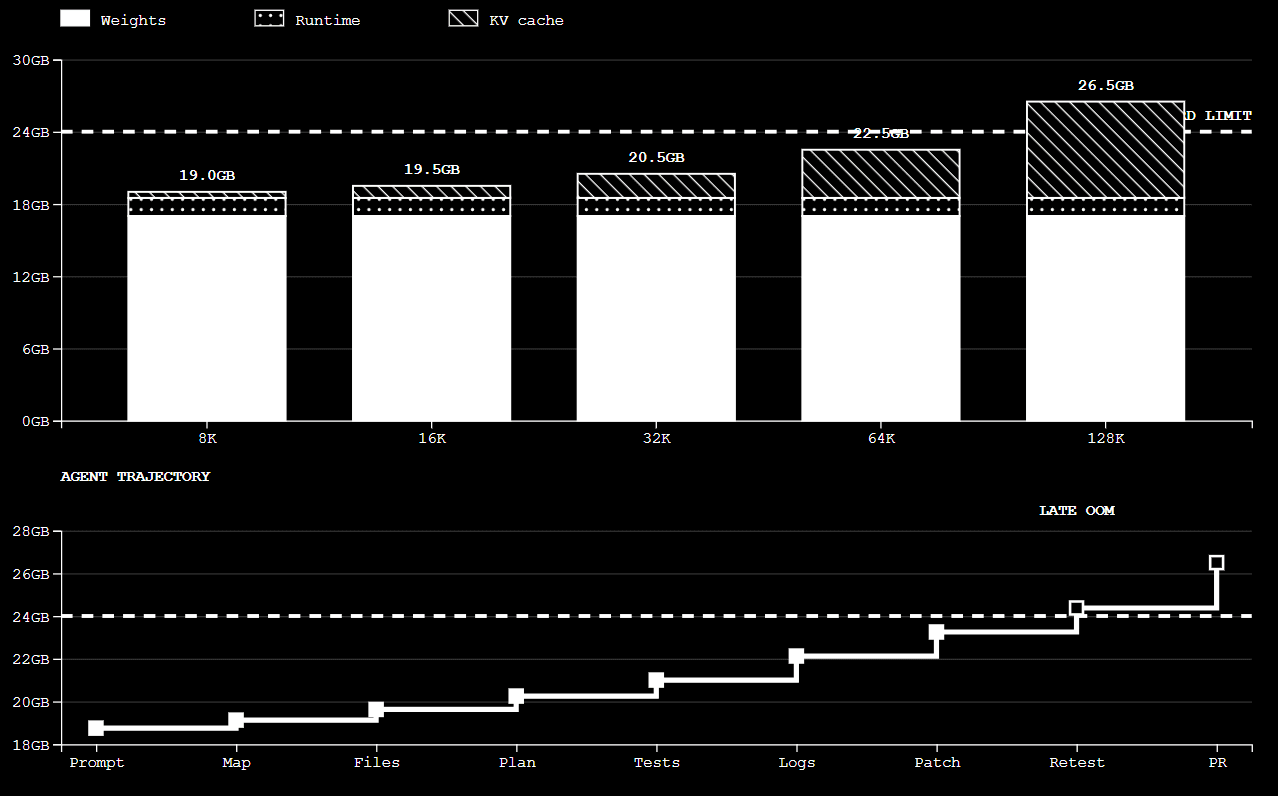
Weights remain fixed while live agent state expands with every retained token.
The important story is therefore is:
A model from Alibaba’s newest agentic and coding generation may fit on one ordinary developer GPU, leaving enough hardware budget to build an actual product around it.
As of August 6, 2026, the Qwen3.8–27B weights, model card, license, architecture, context limit, and benchmarks have not yet been published.
Let’s have a look what we will have in our hands and how we can set it up for meaningful workloads.
The 17GB headline is incomplete
Unsloth said Qwen3.8–27B would run locally on 17GB RAM or VRAM setups, but did not specify the quantization format, context length, or runtime configuration behind that number.
Basic weight arithmetic explains where that number comes from.
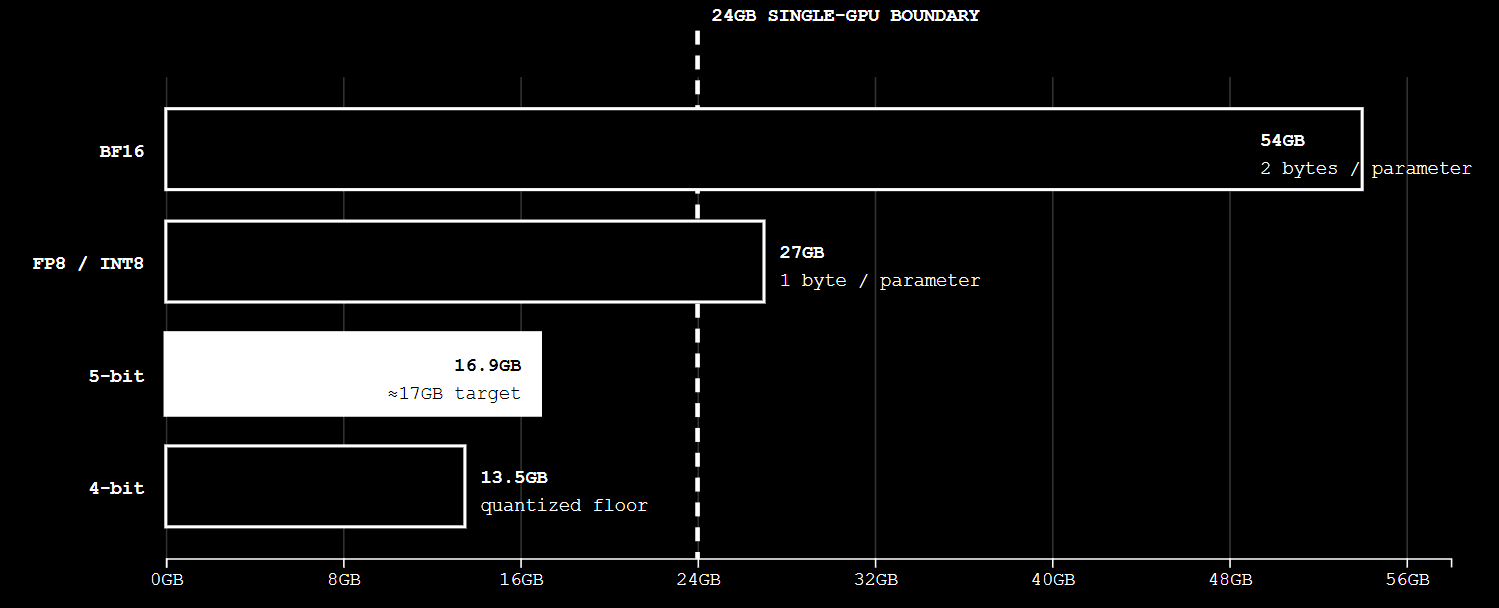
A 27-billion-parameter model requires approximately:
BF16: 54GB
FP8 or INT8: 27GB
6-bit: 20.25GB
5-bit: 16.88GB
4-bit: 13.5GB
The exact files will be larger or smaller depending on the true parameter count, quantization metadata, embeddings, vision components, alignment, and whether “27B” is rounded.
Qwen3.6–27B, for example, has closer to 27.8 billion parameters and roughly 55.6GB of BF16 weight files.
Its theoretical 5-bit footprint lands around 17.4GB.
So the most plausible interpretation is that 17GB refers to a roughly 5-bit quantization or a heavily optimized 4-bit build with additional model data.
That is still impressive but it is just not the same as saying that a 17GB GPU can comfortably run a long-context, multimodal coding agent with multiple users.
Weights are only the memory floor and an inference process also needs memory for:
KV cache
activation and workspace buffers
CUDA graphs or compiled kernels
tokenization and request queues
multimodal encoders
speculative decoding state
concurrent sequences
the inference server itself
The practical hardware target is therefore likely to be 24GB VRAM, even when the downloadable quantized model is around 17GB.
16GB card may run a smaller 4-bit quantization with short context, partial CPU offload, or reduced GPU layers.
24GB card gives you room to run the model instead of merely proving that it loads.
32GB card should make longer context and more aggressive caching less painful.
You should always remember that although the model weights stay constant, the context state does not.
Editor’s note: If you want to dive deep into Local LLMs and Agentic Stack, you can join our Agent Foundry program for hands-on, in-depth trainings.
Why the 27B model may matter more than Qwen3.8-Max
Qwen3.8-Max is the model that generated the launch headlines.
Alibaba describes it as a 2.4-trillion-parameter system built around coding, multimodal work, and long-running autonomous workflows. The launch examples include more than ten days of autonomous coding, hundreds of chip-design optimization turns, and long-horizon business simulations.
A multi-trillion-parameter mixture-of-experts model may activate only a fraction of its parameters per token, but its complete weights still need to be stored across a large serving system.
Qwen3.8–27B sits on the opposite side of that infrastructure boundary because a 27B model can potentially be:
hosted on a single workstation GPU
deployed inside a private network
stood up for a single development team
quantized for laptops and unified-memory systems
fine-tuned or adapted on realistic budgets
exposed through an OpenAI-compatible endpoint
swapped into existing coding-agent harnesses
This is why the smaller announcement may matter more to product engineers as most teams need a model that can reliably run thousands of bounded agent tasks:
triage an issue
inspect a repository
propose a patch
execute tests
explain a failure
update a pull request
extract structured data
operate an internal tool
perform a repeated back-office workflow
The previous model, Qwen3.6–27B, already provides a strong baseline for what this size class can do, which supports a native 262,144-token context window, includes a vision encoder, uses a hybrid linear/full-attention architecture, and was explicitly improved for repository-level reasoning and agentic coding.
Its vendor-reported coding-agent results include:
SWE-bench Verified: 77.2
SWE-bench Pro: 53.5
SWE-bench Multilingual: 71.3
Terminal-Bench 2.0: 59.3
SkillsBench: 48.2
NL2Repo: 36.2
These results should not be interpreted as pure, model-only intelligence scores.
Alibaba evaluated the model through specific agent scaffolds, tools, context limits, temperatures, and execution environments.
For example, its SWE-bench evaluations used an internal bash and file-editing scaffold, while SkillsBench was run through OpenCode.
Agent performance is a property of the model plus the harness.
A 27B model with the correct chat template, tool parser, repository retrieval strategy, retry policy, sandbox, and verification loop may outperform a much larger model connected through a poorly designed agent runtime.
This is very good news because model quality is rented but harness quality is owned by us.
The memory math that decides whether your agent works
Assume, temporarily, that Qwen3.8–27B resembles Qwen3.6–27B.
That assumption may be wrong but Qwen3.6 gives us the most defensible planning baseline available today.
Qwen3.6–27B has 64 language-model layers.
Its architecture is organized into 16 repeating blocks, each containing three Gated DeltaNet layers followed by one conventional gated-attention layer.
The full-attention layers use four KV heads with a head dimension of 256.
Using those published dimensions, a rough BF16 KV-cache estimate for the full-attention layers is:
That gives an approximate per-sequence cache footprint of:
8K tokens: 0.5GB
16K tokens: 1GB
32K tokens: 2GB
64K tokens: 4GB
128K tokens: 8GB
262K tokens: 16GB
This is a simplified estimate based on the predecessor’s documented full-attention structure and it excludes linear-attention state, allocator overhead, runtime workspaces, multimodal tokens, fragmentation, and framework-specific optimizations.
It should be treated as capacity-planning math, not as a measured Qwen3.8 requirement.
The conclusion is still useful.
A 17GB quantized model plus an 8GB long-context cache does not fit into 24GB VRAM.
Therefore:
“Runs in 17GB” and “runs a 128K coding agent on a 24GB GPU” are completely different claims.
For a single-user local agent, start with a 16K or 32K context limit and increase it only after measuring the real memory curve.
For a team endpoint, context length is only half the problem.
KV cache scales with concurrent sequences.
Four simultaneous 32K sessions can require roughly as much cache as one 128K session.
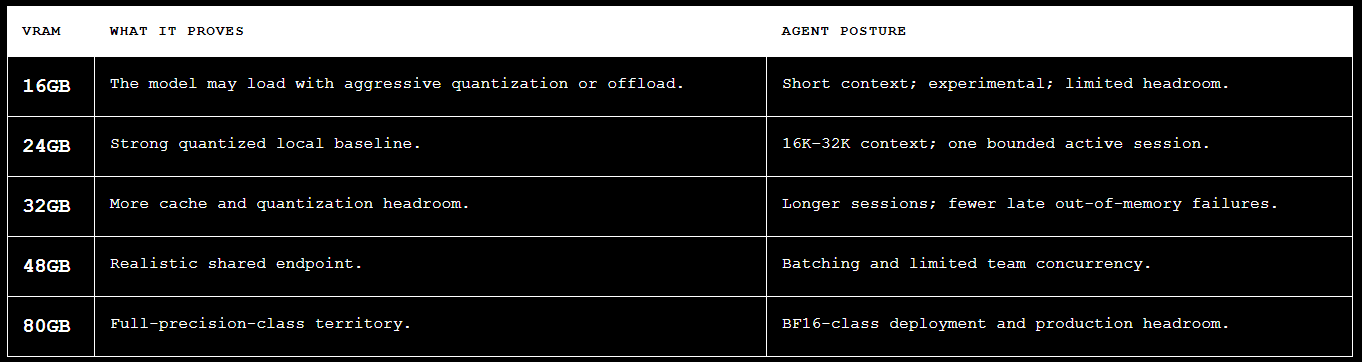
A practical planning table looks more like this:
Laptop or unified memory, 32GB system memory: 4-bit GGUF, short context, partial acceleration.
16GB GPU, experimental: tight 4-bit quant, 8K to 16K context, possible CPU offload.
24GB GPU, strong local baseline: 4-bit or approximately 5-bit, 16K to 32K context.
48GB GPU, team server: FP8 or high-quality quant, batching, longer context.
80GB GPU, full-precision deployment: BF16, larger cache, production serving.
Select hardware based on weights + maximum live KV cache + concurrent requests + runtime overhead + safety margin.
For a coding agent, a 15% safety margin is not excessive.
It is often the difference between stable inference and random out-of-memory failures halfway through a repository migration.
Quick start before the weights land
There is no official Qwen3.8–27B repository to install as of August 6, 2026.
The best preparation strategy is to build against Qwen3.6–27B now and make the model identifier configurable.
That gives you time to validate your GPU drivers, inference server, OpenAI-compatible client, tool schemas, observability, context policy, and agent harness.
When Qwen3.8 arrives, swapping the weights should be the smallest part of the migration.
For a 24GB local workstation, the fastest current path is a quantized GGUF build served by llama.cpp.
Unsloth publishes Qwen3.6–27B GGUF variants and documents a one-command OpenAI-compatible server.
The --language-model-only option skips vision-model initialization and multimodal profiling, freeing memory for text inference and KV cache. Qwen includes this option in its official vLLM deployment guidance for Qwen3.6.
For a full-precision or FP8 deployment, use the actual model format your GPU and inference framework support.
Qwen3.6 runs in thinking mode by default.
For precise coding work, Qwen recommends a temperature of 0.6, top_p=0.95, and top_k=20.
It also exposes a template option for disabling thinking when direct answers are more appropriate.
A minimal client looks like this:
Code
python
from openai import OpenAI

client = OpenAI(
  base_url="http://127.0.0.1:8000/v1",
  api_key="EMPTY",
)

response = client.chat.completions.create(
  model="Qwen/Qwen3.6-27B",
  messages=[
      {
          "role": "system",
          "content": (
              "You are a senior software engineer. "
              "Inspect assumptions, propose the smallest safe change, "
              "and include a verification plan."
          ),
      },
      {
          "role": "user",
          "content": (
              "Our Python API occasionally creates duplicate jobs. "
              "List the likely race conditions and propose an idempotent design."
          ),
      },
  ],
  temperature=0.6,
  top_p=0.95,
  max_tokens=4096,
  extra_body={
      "top_k": 20,
  },
)

print(response.choices[0].message.content)
Once the official Qwen3.8 model card appears, check five things before changing MODEL_ID:
License file: determines whether you can deploy commercially.
Architecture and config: determine framework compatibility and cache behavior.
Official context length: determines KV-cache planning.
Chat template: determines reasoning and tool-call formatting.
Recommended framework versions: prevent subtle parser and kernel failures.
Previous Qwen open-weight models have commonly used Apache 2.0, but the Qwen3.8–27B license has not been published so do not treat precedent as legal permission.
Build a local tool-using coding agent
Serving the model is not the same as building an agent. An agent needs a controlled execution loop:
user objective
→ model decision
→ validated tool call
→ sandboxed execution
→ structured observation
→ model verification
→ final response
The model should never receive unrestricted shell access simply because it produced valid JSON.
The following Python example gives the model access to a restricted project directory.
It can list files and read text files, but it cannot escape the configured root, it also caps tool rounds so a malformed trajectory cannot loop forever.
Code
python
from __future__ import annotations

import json
import os
from pathlib import Path
from typing import Any

from openai import OpenAI

ROOT = Path(os.getenv("AGENT_ROOT", ".")).resolve()
MODEL_ID = os.getenv("MODEL_ID", "Qwen/Qwen3.6-27B")
MAX_TOOL_ROUNDS = 12

client = OpenAI(
  base_url=os.getenv("OPENAI_BASE_URL", "http://127.0.0.1:8000/v1"),
  api_key=os.getenv("OPENAI_API_KEY", "EMPTY"),
)
Code
python
def resolve_inside_root(relative_path: str) -> Path:
  candidate = (ROOT / relative_path).resolve()

  if candidate != ROOT and ROOT not in candidate.parents:
      raise ValueError(f"Path escapes agent root: {relative_path}")

  return candidate
Code
python
def list_files(path: str = ".") -> dict[str, Any]:
  directory = resolve_inside_root(path)

  if not directory.exists():
      return {"error": "Path does not exist"}

  if not directory.is_dir():
      return {"error": "Path is not a directory"}

  entries = []
  for item in sorted(directory.iterdir())[:200]:
      entries.append(
          {
              "name": item.name,
              "path": str(item.relative_to(ROOT)),
              "type": "directory" if item.is_dir() else "file",
          }
      )

  return {"entries": entries}
Code
python
def read_file(path: str) -> dict[str, Any]:
  file_path = resolve_inside_root(path)

  if not file_path.exists():
      return {"error": "File does not exist"}

  if not file_path.is_file():
      return {"error": "Path is not a file"}

  if file_path.stat().st_size > 1_000_000:
      return {"error": "File exceeds 1MB read limit"}

  try:
      content = file_path.read_text(encoding="utf-8")
  except UnicodeDecodeError:
      return {"error": "File is not UTF-8 text"}

  return {
      "path": str(file_path.relative_to(ROOT)),
      "content": content,
  }
def parse_arguments(raw_arguments: Any) -> dict[str, Any]:
  # OpenAI-compatible servers normally return a JSON string.
  # Some backends or versions may already return a dictionary.
  if isinstance(raw_arguments, dict):
      return raw_arguments

  if not isinstance(raw_arguments, str):
      raise ValueError("Tool arguments must be JSON text or an object")

  parsed = json.loads(raw_arguments)

  if not isinstance(parsed, dict):
      raise ValueError("Tool arguments must decode to an object")

  return parsed
Code
python
def execute_tool(name: str, arguments: dict[str, Any]) -> dict[str, Any]:
  if name == "list_files":
      return list_files(**arguments)

  if name == "read_file":
      return read_file(**arguments)

  return {"error": f"Unknown tool: {name}"}
Code
python
def run_agent(objective: str) -> str:
  messages: list[dict[str, Any]] = [
      {
          "role": "system",
          "content": (
              "You are a repository analysis agent. "
              "Use tools to inspect the project before making claims. "
              "Do not invent files or code. "
              "Return findings, risks, and a concrete implementation plan."
          ),
      },
      {
          "role": "user",
          "content": objective,
      },
  ]

  for _ in range(MAX_TOOL_ROUNDS):
      response = client.chat.completions.create(
          model=MODEL_ID,
          messages=messages,
          tools=TOOLS,
          tool_choice="auto",
          temperature=0.6,
          top_p=0.95,
          max_tokens=4096,
          extra_body={"top_k": 20},
      )

      message = response.choices[0].message
      messages.append(message.model_dump(exclude_none=True))

      if not message.tool_calls:
          return message.content or ""

      for tool_call in message.tool_calls:
          try:
              arguments = parse_arguments(tool_call.function.arguments)
              result = execute_tool(tool_call.function.name, arguments)
          except Exception as exc:
              result = {"error": str(exc)}

          messages.append(
              {
                  "role": "tool",
                  "tool_call_id": tool_call.id,
                  "content": json.dumps(result),
              }
          )

  raise RuntimeError("Agent exceeded maximum tool rounds")
Code
json
if __name__ == "__main__":
  print(
      run_agent(
          "Inspect this repository and identify where request retries "
          "could create duplicate side effects."
      )
  )
This is intentionally less capable than Claude Code, OpenCode, Cline, or a full Qwen-Agent deployment.
First prove that the model:
selects the correct tool,
emits valid arguments,
respects path boundaries,
recovers from tool errors,
stops when the task is complete.
Then add writing, patch application, test execution, Git operations, or browser control.
You can also connect Qwen-Agent to a locally served OpenAI-compatible endpoint and attach an MCP filesystem server.
It supports options for preserving reasoning across historical messages, which may be useful for long-running development trajectories.
Do not assume every OpenAI-compatible server behaves identically, though because recent llama.cpp issues showed edge cases involving malformed tool arguments, JSON-object versus JSON-string differences, and Qwen tool calls appearing in unexpected reasoning fields.
For production agentic workloads, test the complete matrix:
Model quantization: tool accuracy, coding quality, reasoning regressions.
Chat template: system-prompt adherence and multi-turn stability.
Tool parser: single, parallel, nested, and malformed calls.
Context policy: truncation, summarization, and cache growth.
A local model moves the platform engineering into your repository.
Production architecture and the practical verdict
The good architecture is a shared internal endpoint:
Keep the model server boring: It should load weights, batch requests, manage cache, and expose a stable API.
Keep agent behavior outside the model server.
The orchestration layer should own:
system prompts
model routing
context construction
tool permissions
retries
timeouts
approval gates
trajectory storage
evaluation
fallback to hosted models
This separation lets you replace Qwen3.6 with Qwen3.8, upgrade from GGUF to AWQ, move from llama.cpp to vLLM, or route difficult tasks to Qwen3.8-Max without rewriting the agent.
It also gives you a realistic hybrid strategy.
Use the local 27B model for high-volume, bounded tasks:
repository navigation
code explanation
issue classification
test generation
documentation drafts
pull-request summaries
extraction and transformation
first-pass bug investigation
Escalate difficult trajectories when:
the agent repeats the same tool call
tests continue to fail
confidence drops
the patch spans critical systems
the context exceeds the local capacity
the task requires stronger visual or long-horizon reasoning
The release-day questions are straightforward:
Does the official quant actually fit in 17GB?
At what bit rate?
Is the model dense?
Does it preserve Qwen3.6’s hybrid-attention efficiency?
What happens to coding benchmarks after quantization?
Does tool calling work across vLLM, SGLang, and llama.cpp?
How much context fits on a 24GB card?
Is the license suitable for commercial use?
Is vision included in the 17GB figure?
Can one GPU support multiple active agents?
Still, the direction is hard to ignore.
Qwen3.6–27B already demonstrated that a dense model in this size class can deliver serious repository-level coding, terminal operation, visual understanding, and long-context reasoning.
Qwen3.8–27B is arriving from a generation Alibaba is explicitly positioning around coding and long-running agentic work.
If the successor improves capability without breaking deployability, a single 24GB or 32GB GPU may become enough to host the default reasoning engine for a small engineering team.