GLM 5.3 Hits Fable 5-Level Coding Through Better Harness
Agent Native•August 15, 2026
We have spent the last two years talking about model scale, context windows, MoE routing, inference cost, and whether open models can catch closed frontier systems.
GLM-5.3 points at a different bottleneck: the base model may no longer be the main constraint for agentic software engineering.
The training environment around the model increasingly is.
GLM-5.3 expands post-training into longer, more realistic engineering workflows: identifying a problem, analyzing it, implementing changes, verifying the result, and pushing toward a deliverable state.
Some training tasks are described as comparable to several days of senior-engineer work.
There is an important launch-day constraint: GLM-5.3 is available now through the GLM Coding Plan and ZCode, while general API access and open weights are being released in stages after safety evaluations.
So this is not yet a download the weights and deploy them behind vLLM tonight release. It is a coding-agent release first.
And that tells us something about where the model market is going.
The real competition is moving to “which model can realistically remain useful after the 50th tool call, the fifth failed test, and the third change in plan?”
Let’s have a brief look at the benchmarks.
What Actually Changed in GLM-5.3?
GLM-5.3 keeps the same base model as GLM-5.2 and gets its improvements from scaled post-training:
1M context length
128K maximum output tokens
thinking modes
streaming
function calling
context caching
structured output
MCP integration
GLM-5.2 already pushed heavily into long-context and long-horizon work, the meaningful change is the optimization target.
GLM-5.3’s training goes beyond isolated programming problems and covers a full workflow: problem identification → analysis → implementation → verification → delivery
That is much closer to an agent trajectory than a benchmark prompt.
In practical development scenarios, repository tasks fail because of accumulated state:
a test fails after a change in a distant package,
a migration requires touching schemas, API handlers, clients, and docs,
one fix introduces another regression,
terminal output changes the plan,
the agent needs to remember what it already tried,
the model needs to decide when to inspect, edit, run, revert, or ask.
These are stateful control problems with code as the environment.
GLM-5.3 appears to be explicitly trained against that shape of work.
The Benchmark: Look at the Shape, Not the Rank
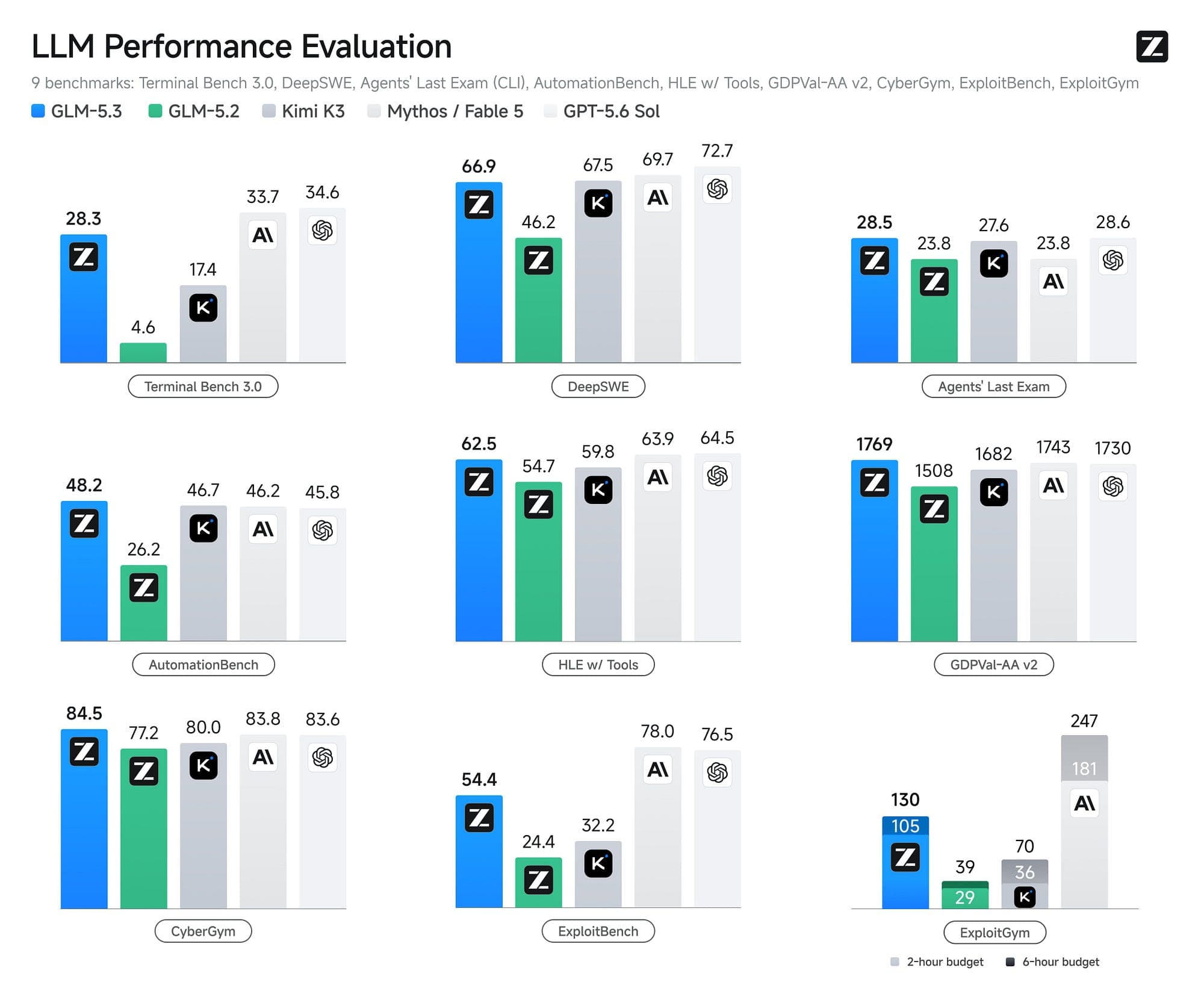
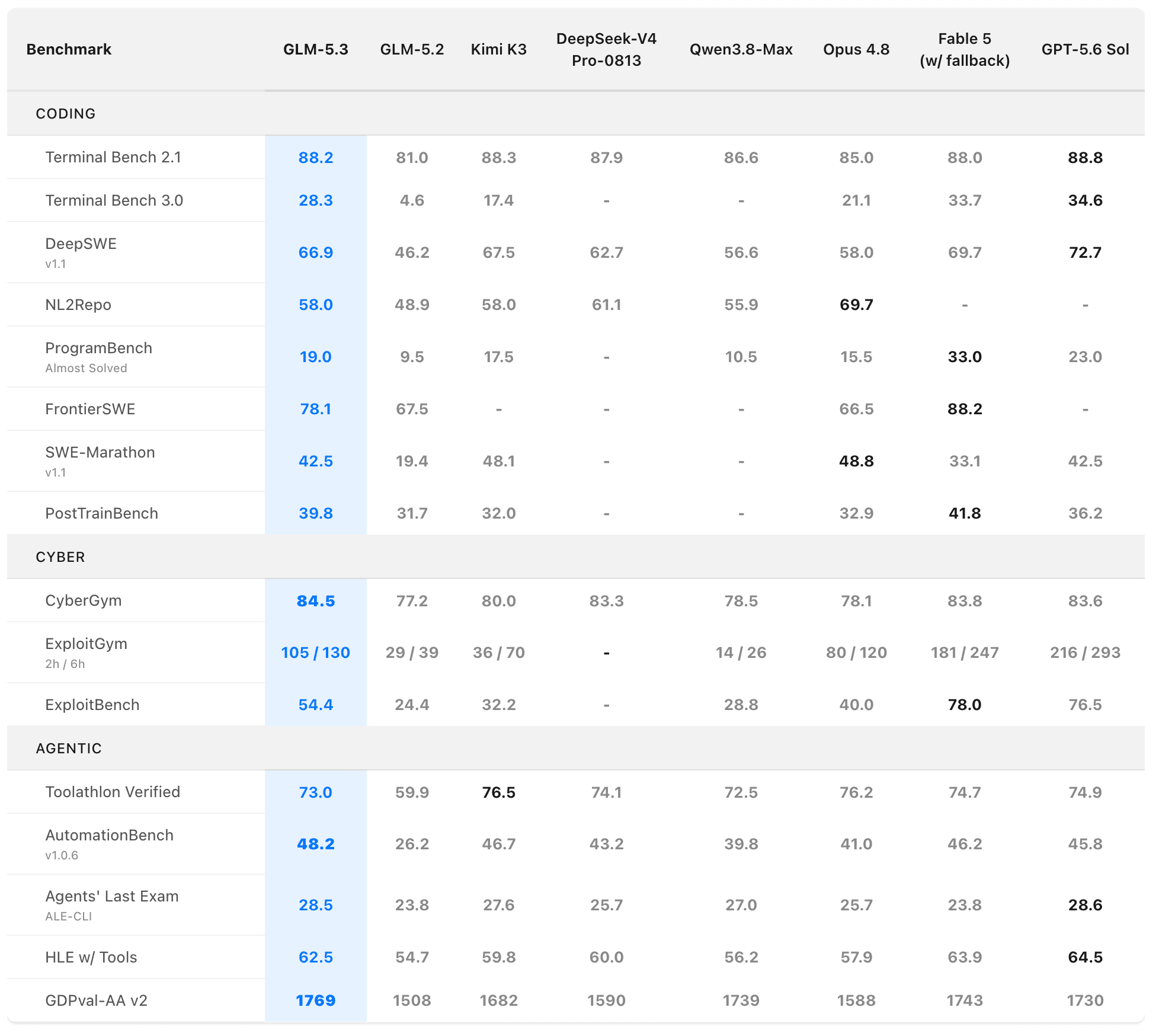
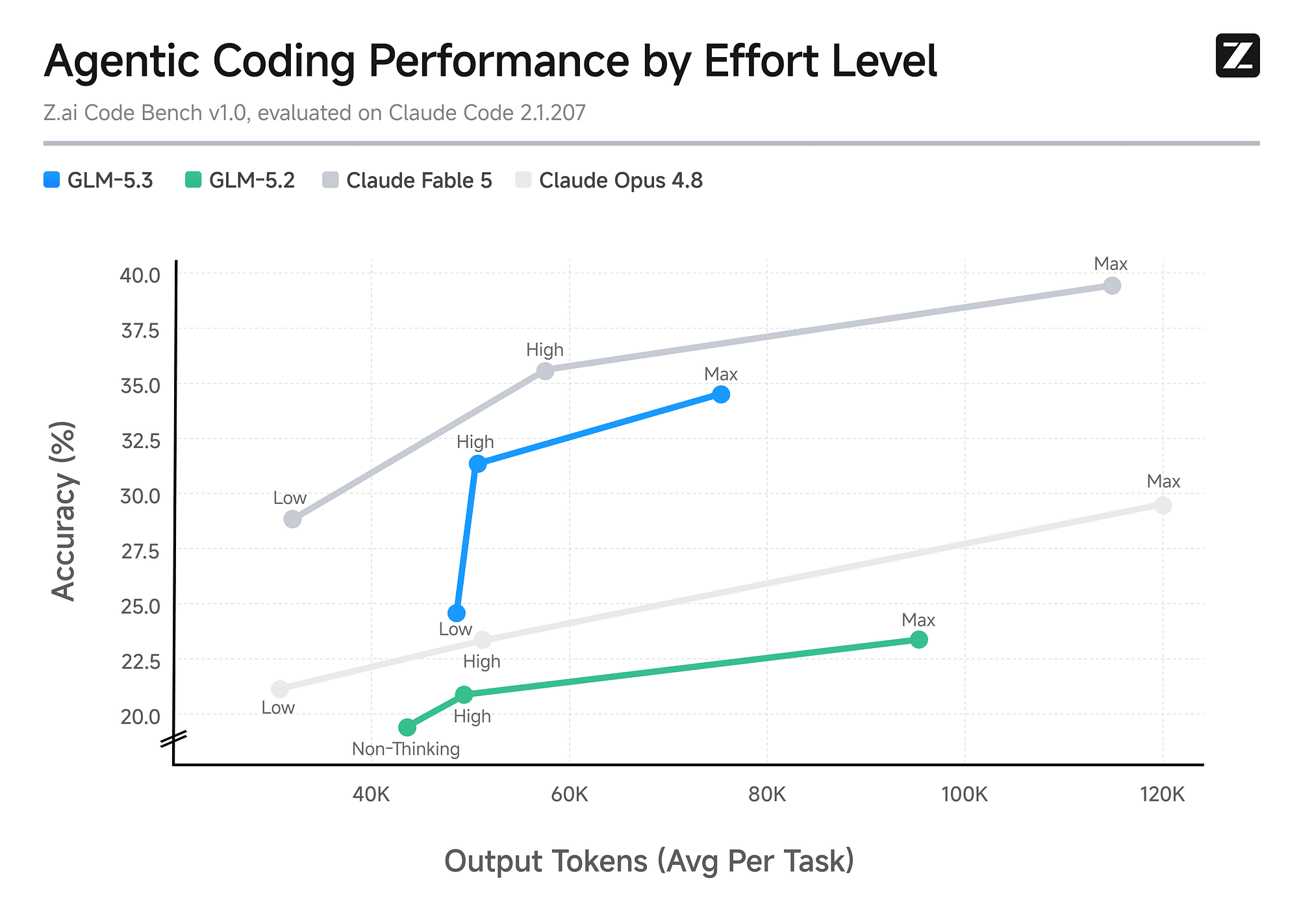
There is a 50% improvement over GLM-5.2 on its internal Code Bench and large gains across public coding and agent benchmarks.
Besides vendor-reported launch results, the direction of improvement is useful.
The biggest signal is that the same underlying base model moved dramatically on benchmarks that reward sustained interaction with environments.
Terminal-Bench evaluates agents inside real terminal environments rather than asking them to return a static answer.
DeepSWE uses original long-horizon software-engineering tasks across active repositories.
AutomationBench evaluates agents that have to orchestrate workflows across simulated SaaS systems and leave the environment in the correct state.
Agents’ Last Exam is designed around economically useful, long-horizon professional work.
Those are very different tests, but they share one property: success requires a sequence of decisions, not one generation.
Terminal-Bench 3.0 Is the Number I Would Watch
GLM-5.2 scores 4.6 on the launch chart for Terminal-Bench 3.0, but GLM-5.3 scores 28.3.
That is a huge jump from a post-training update on the same base.
Terminal-Bench is explicitly designed around agents operating in terminal environments: compiling software, configuring systems, debugging, running tools, and completing end-to-end tasks.
The Terminal-Bench team describes the benchmark as measuring frontier agent work in difficult environments, and Terminal-Bench 3 was designed to keep the best systems around or below roughly a 30% solve rate at launch.
So 28.3 means GLM-5.3 appears much better at staying useful inside a messy execution loop, which is the capability most coding-agent teams actually struggle with.
A weak coding agent often looks smart for the first ten minutes. It can inspect files, generate a plausible plan, and make a few correct edits.
Then it starts to drift:
It forgets why a constraint existed
It repeats a failed command
It fixes the visible test while breaking another package
It prematurely declares success
Or it burns thousands of tokens rediscovering context it already had
Long-horizon quality is largely about reducing those failures.
If GLM-5.3’s gains hold up outside the launch harness, that is a meaningful improvement.
Editor’s note: If you want to dive deep into Local LLMs and Agentic Stack, you can join our Agent Foundry program for hands-on, in-depth trainings.
DeepSWE Is an Even Better Reality Check for Repository Work
DeepSWE is interesting because its tasks are original, long-horizon engineering problems built against active open-source repositories.
The benchmark is explicitly designed to reduce contamination and memorized patch effects.
Its tasks are not simply mined from merged GitHub fixes and then graded against the tests that happened to ship with those fixes:
GLM-5.2: 46.2
GLM-5.3: 66.9
Again, GLM-5.3 does not top the supplied comparison chart, GPT-5.6 Sol and Fable 5 are higher but a roughly twenty-point gain on the same base model is the interesting part.
I would interpret this as a reason to test GLM-5.3 specifically on:
cross-file bug fixes
API migrations
dependency upgrades
framework version migrations
test-suite repair
repository-wide refactors
feature work that crosses service boundaries
Give it the kind of task where your current agent gets 70% of the way there and then loses the plot.
The Cybersecurity Jump Is Useful and a Warning
84.5 on CyberGym, slightly above the comparison numbers shown for Fable 5 and GPT-5.6 Sol, also ExploitBench moving from 24.4 to 54.4.
The security benchmarks are worth understanding because they measure different things.
CyberGym is built from real vulnerabilities in open-source projects and focuses heavily on vulnerability reproduction. Agents receive vulnerable code and need to reason across the codebase to produce proofs that reproduce the issue.
ExploitBench goes further into graded exploitation capability.
ExploitGym evaluates whether agents can turn real vulnerabilities into working exploits in controlled environments.
That is why ready for cyber defense should not be read as a simple code-scanning feature, the capability is dual-use.
A model that becomes better at reasoning across large codebases, finding security-relevant paths, iterating against runtime feedback, and persisting over long tasks will naturally become more useful for both defenders and attackers.
So the current staged rollout makes sense in that context, as API access and open weights will follow safety evaluations, while initial partner access is being expanded through controlled processes with safeguards and usage policies.
This is another signal that your agent architecture and permission design need to advance alongside model capability.
You should not give a stronger coding model unrestricted shell, network, credentials, and production access simply because its benchmark numbers improved.
Launch-Day Access: What You Can Actually Use Right Now
The GLM-5.3 model documentation currently says the general GLM-5.3 API is coming soon.
At the same time, GLM-5.3 is available to users of the GLM Coding Plan, and ZCode is built around the model.
That means if your goal is trying the model on real repositories, you can do that today.
If your goal is embedding GLM-5.3 into your own production agent backend, you should design the adapter now but wait for the official API rollout rather than inventing undocumented endpoints.
If your goal is self-hosting, wait for the GLM-5.3 weights and model card. The existing GLM-5 repository already documents vLLM and SGLang deployment for earlier GLM-5-family checkpoints, but copying those commands and swapping in a model name that does not yet have released weights would be fake setup guidance.
Repository Code Is a Better Evaluation Surface
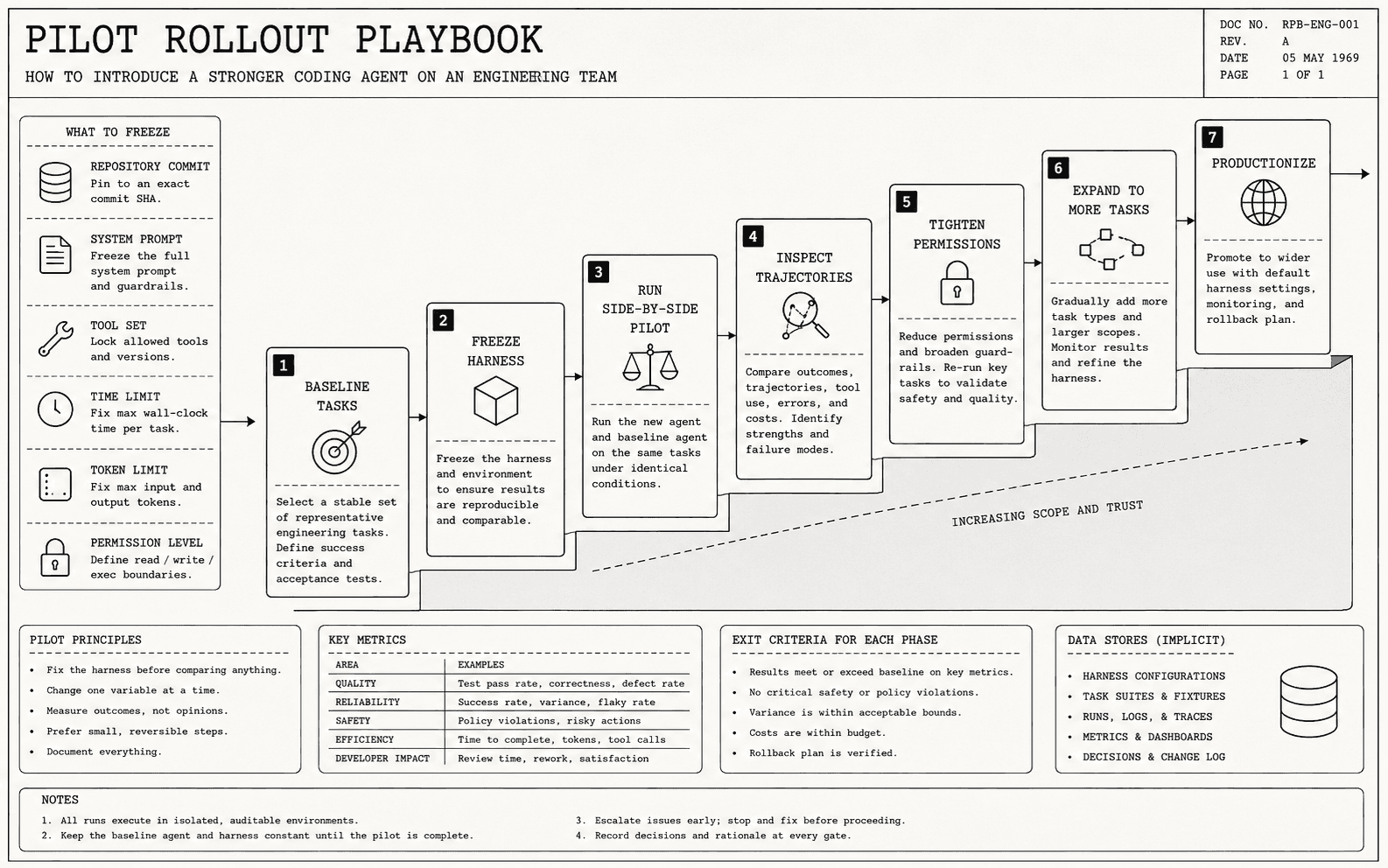
The fastest way to misunderstand a coding model is to evaluate it in a blank chat window.
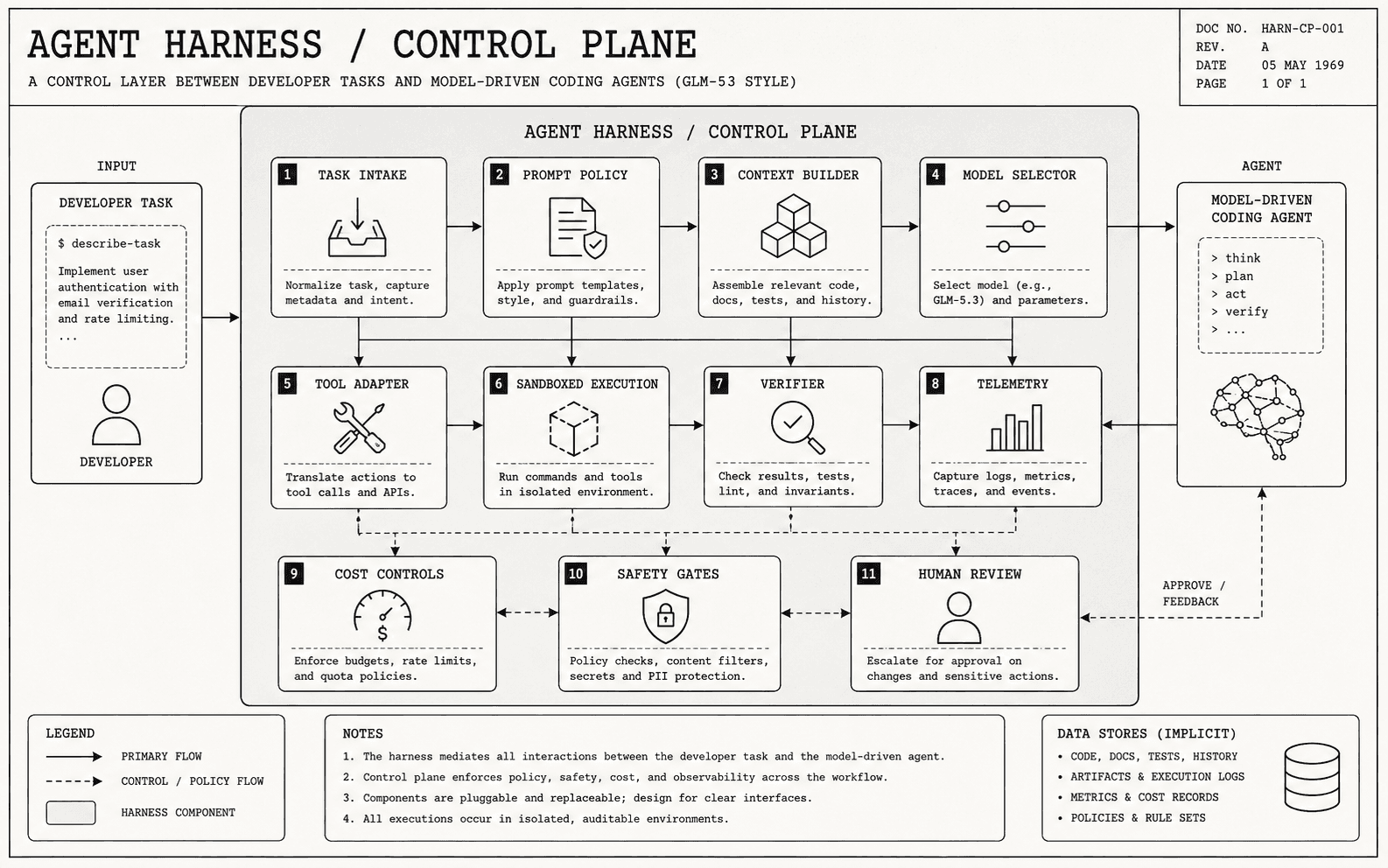
Agentic coding quality comes from the interaction between:
model × prompt × repository context × tools × permissions × verifier × time budget
Change any of those and the result can move dramatically.
Build a small internal eval set from your own engineering history.
Take 20 to 50 completed tasks from real repositories:
bug fixes
migrations
dependency upgrades
performance investigations
flaky tests
refactors
code-review findings
Rewind the repository to the commit before the fix and give each model the same environment.
Then score the output with deterministic checks whenever possible.
A useful harness might record:
Signal Why it matters
task success Did the final repository satisfy acceptance tests?
test regressions Did the agent break unrelated behavior?
files touched Did it over-edit?
tool calls How much interaction was required?
wall-clock time Can developers tolerate the loop?
output tokens How expensive is the trajectory?
retries / repeated commands Does the model get stuck?
human interventions How autonomous was it really?
security violations Did it attempt disallowed operations?
This is much closer to measuring an agent than measuring an LLM.
Fewer Output Tokens Could Matter More Than a Small Benchmark Lead
GLM-5.3 improves agentic coding while using fewer output tokens under similar token budgets.
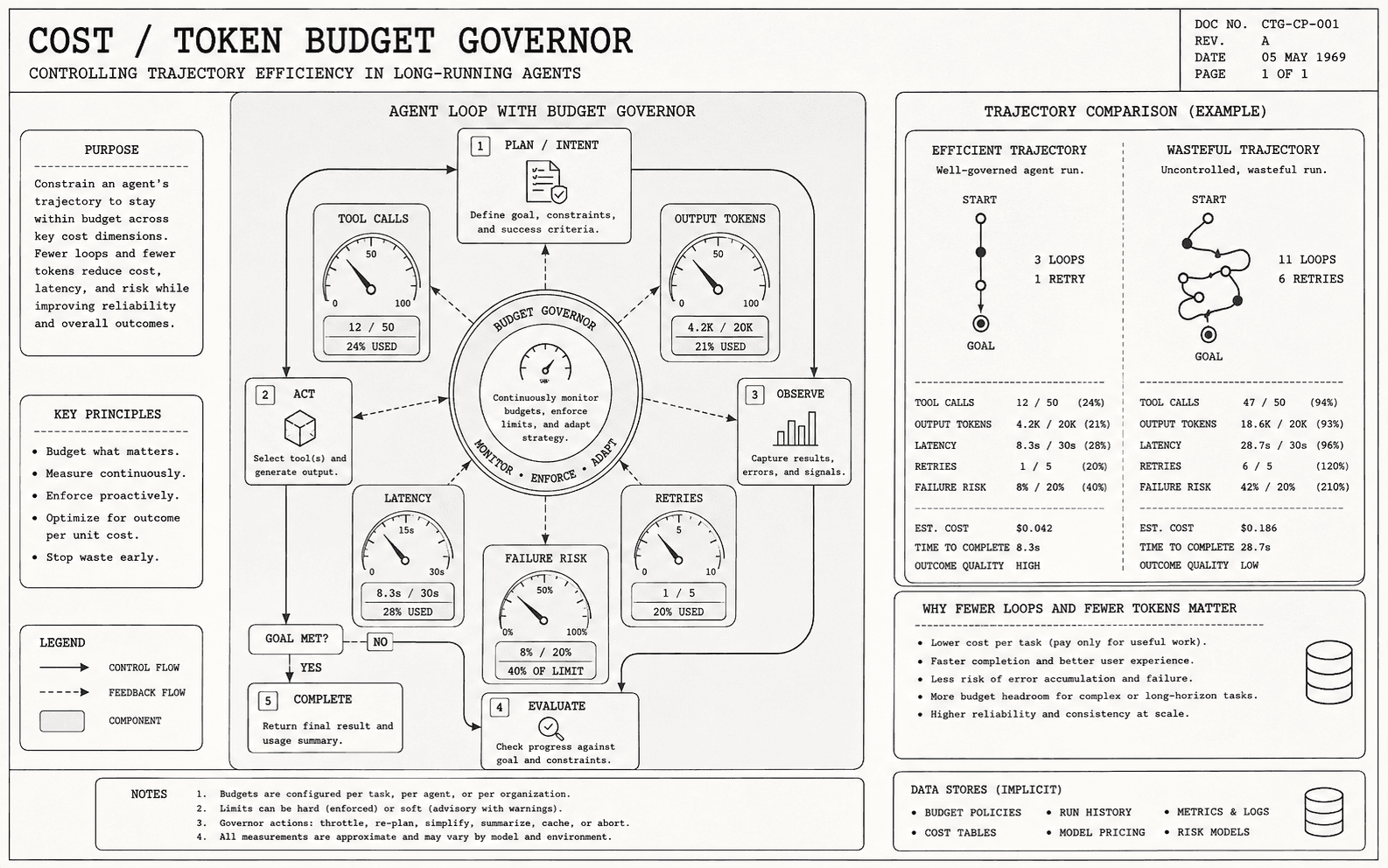
For long-running agents, model quality is only half the cost equation and the other half is trajectory efficiency.
An agent that reaches the same result in:
40 tool calls instead of 90
30K output tokens instead of 80K
one clean plan instead of four restarts
can be more useful even if its single-shot benchmark score is similar.
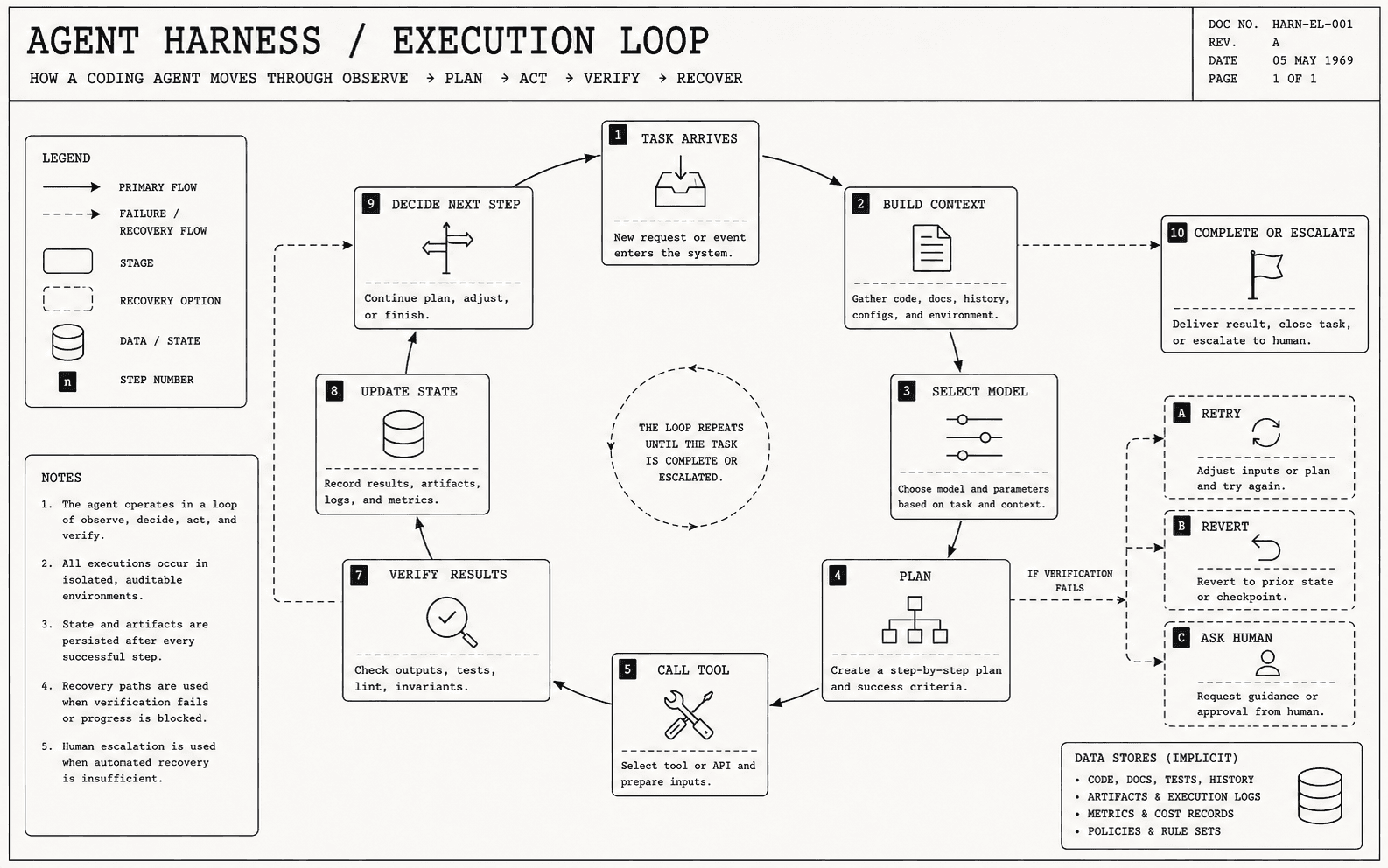
A production agent has a loop:
observe
→ reason
→ call tool
→ parse result
→ update plan
→ call another tool
→ verify
→ recover
→ continue
Every additional cycle adds latency, tokens, tool cost, and failure probability.
So the metric I want from future model releases is not just pass rate.
I want successful tasks per dollar and successful tasks per minute under a fixed harness.
That is a much better product metric.
Concluding Thoughts
There is also a broader implication here.
If Z.ai can move from GLM-5.2 to GLM-5.3 with a large gain in coding-agent behavior while retaining the same base model, then part of the agent intelligence we attribute to foundation models may actually be highly trainable at the post-training layer.
That suggests a future where model providers differentiate on:
environment diversity
tool-use trajectories
recovery behavior
verifier quality
anti-reward-hacking techniques
long-horizon reinforcement learning
domain-specific agent training
In other words, agentic capability becomes an engineering discipline around the base model.
That is good news for application teams.
You do not control pretraining but you do control your harness.
The model matters enormously, but it is not the complete agent.