It is a provider-neutral control plane for agent swarms.
It runs agent workers as independent processes, coordinates them with leases, stores their results as typed SQLite artifacts, routes each task to the cheapest sufficient model, and stitches the final answer from structured outputs instead of raw chat logs.
You do not build a new agent from primitives but put a supervisor in front of the agent tools you already use: Cursor, Claude Code, OpenAI/Codex, Hermes, or a direct provider API through the built-in agentic worker.
Let’s have a look at why durable state beats shared transcript.
The problem Puppetmaster is solving
Agentic software engineering creates an infrastructure problem.
The workflow includes:
long repo investigations
conflicting hypotheses
multiple tool-capable workers
provider fallback
patch attribution
live progress inspection
approval gates
reusable memory
cost controls
repeatable routing decisions
Native IDE subagents help with parallel exploration, and tools like Claude Code now support custom subagents, hooks, MCP, skills, and parallel work.
Subagents have independent contexts that preserve the main conversation and can be routed to cheaper models for specific task types.
That is useful but Puppetmaster goes one layer lower and one layer wider.
Instead of asking one host product to manage every child agent inside its own session, Puppetmaster turns the host agent into an operator and moves the real coordination into a local runtime.
The control flow becomes:
Cursor / Claude Code / OpenAI / Codex / Hermes / agentic / shell
|
v
Puppetmaster supervisor -> task-aware model router
|
v
independent worker processes -> SQLite artifacts, events, memory
|
v
live artifact board -> stitched summary -> zero-token follow-up reads
That is closer to Gunicorn, Redis, or a local workflow engine than a group chat and the important word is runtime.
Puppetmaster treats a swarm run as a job and a job contains tasks.
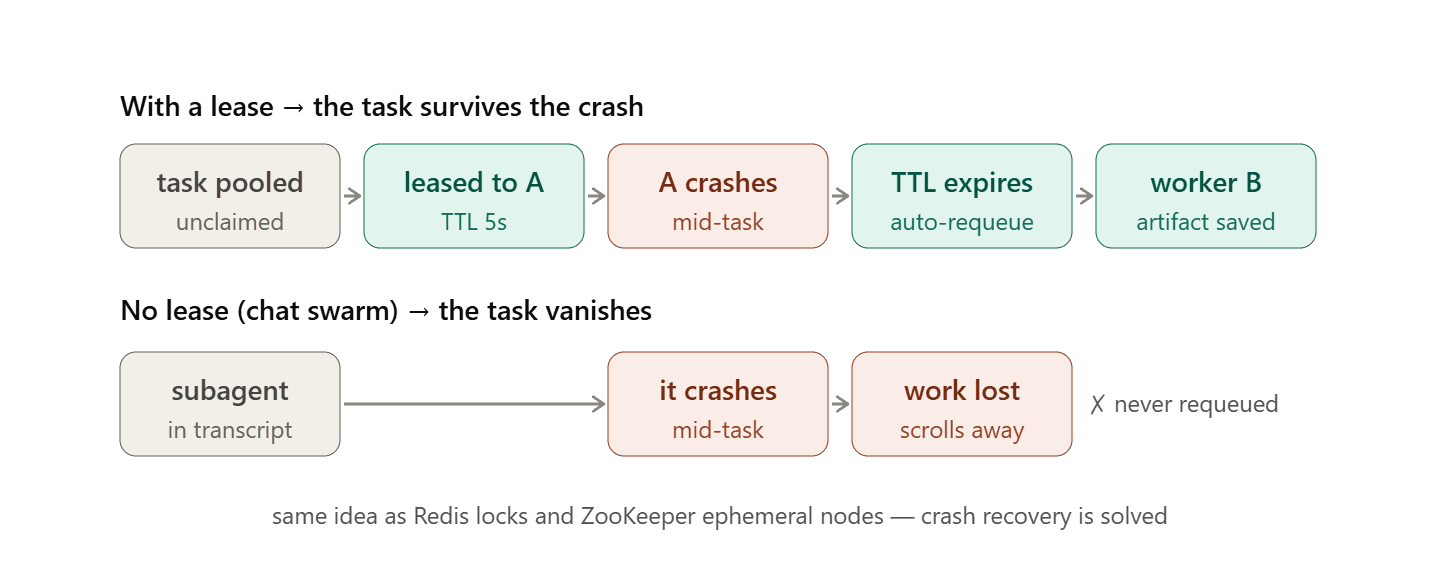
Tasks are claimed by workers through leases, workers emit artifacts., and artifacts include payload, evidence, confidence, and hash integrity.
Then the stitcher reads artifacts and writes the final summary.
The core objects are:
Job: one swarm run and user goal
Task: a role-specific unit of work, optionally dependent on other tasks
AgentRun: one attempt by one worker process
Artifact: structured worker output with evidence, confidence, payload, and sha256
MemoryRecord: promoted facts that future workers can retrieve
This sounds much more useful in practice.
Editor’s note: To celebrate reaching 10,000 community members on Medium, who relentlessly design, ship, and iterate on agents every day, we’re also making the full repository available for free, which is part of our Agent Foundry program.
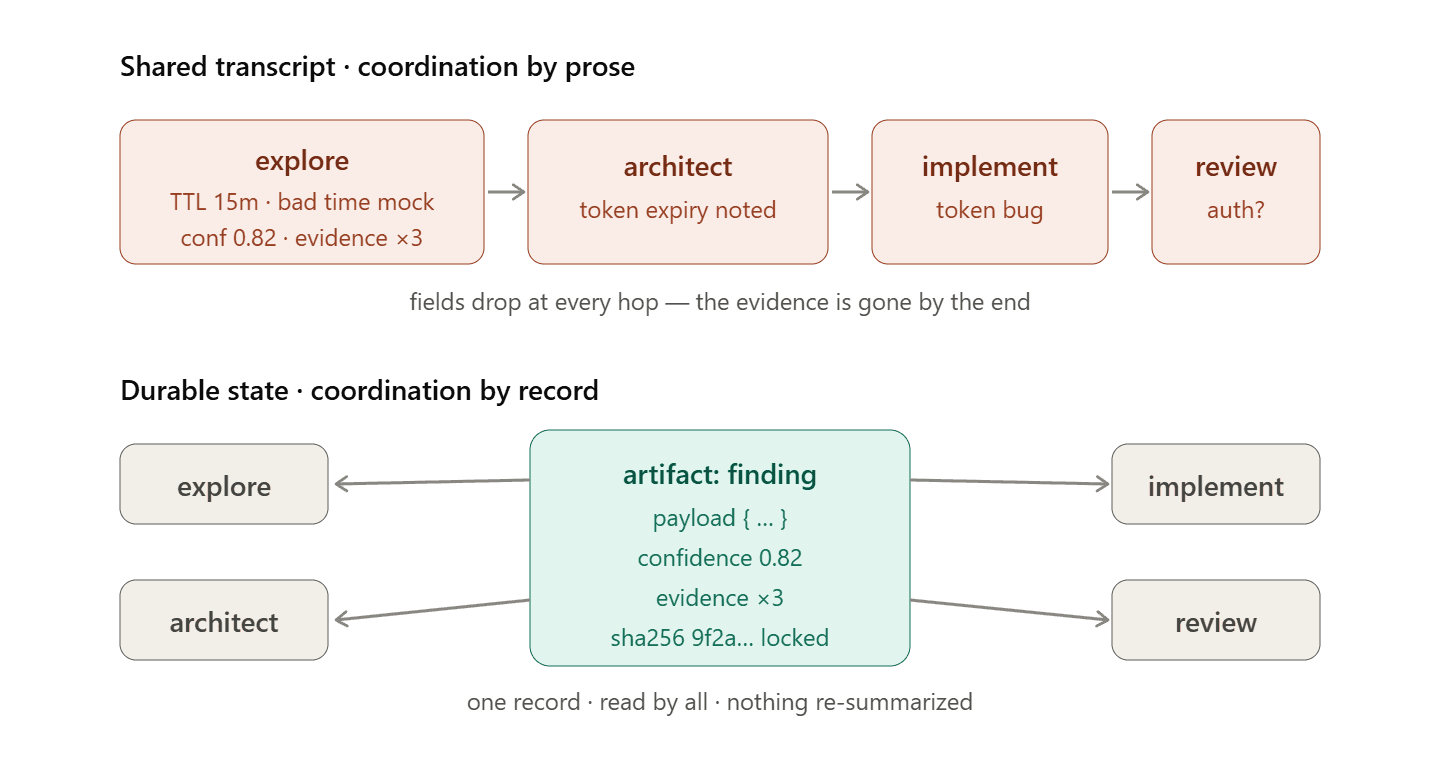
Why durable state beats shared transcript
The common parent chat plus subagents model creates hidden coupling.
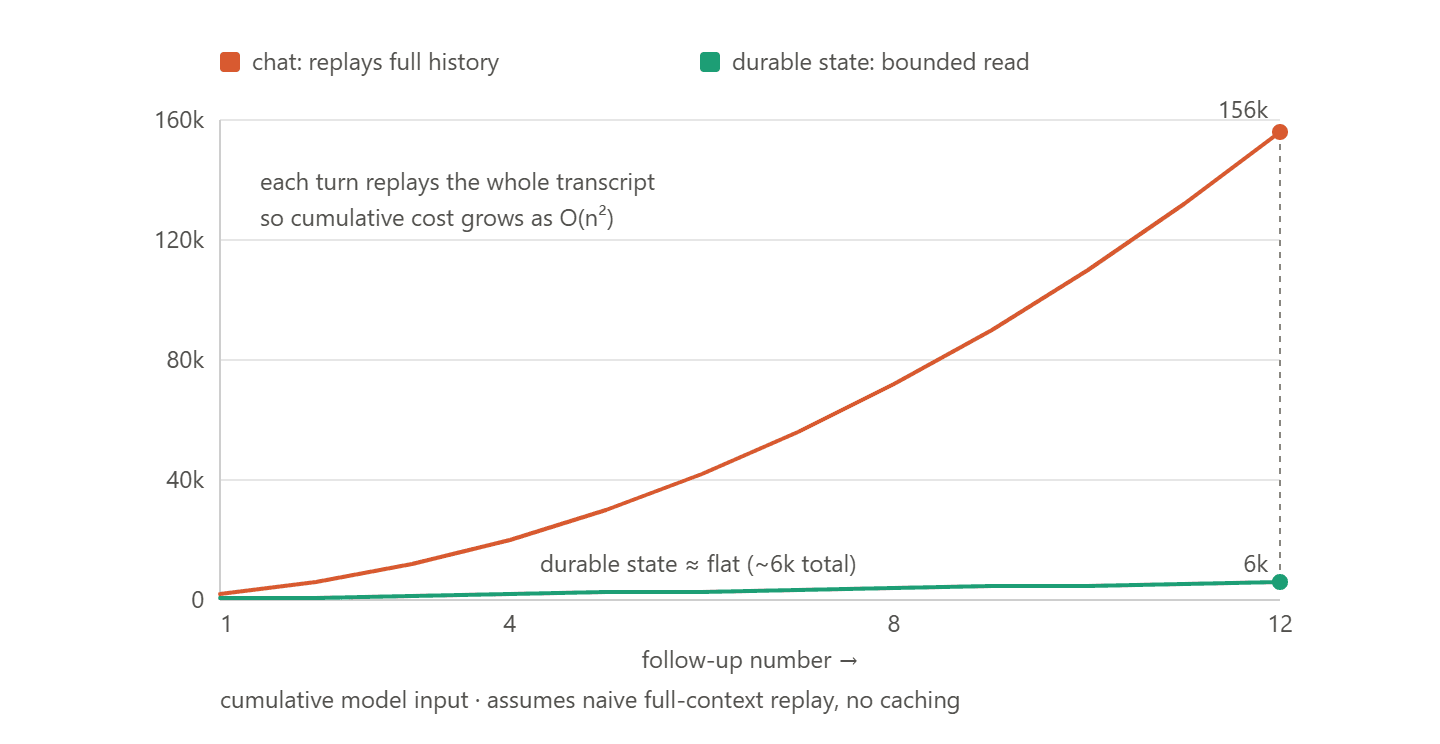
In a chat swarm, every follow-up re-sends the whole transcript, so turn n processes roughly n turns’ worth of context.
Per turn that’s linear but cumulatively it’s quadratic, O(n²).
Your tenth follow-up isn’t a little more expensive than your first, the running total is an order of magnitude higher, and it’s invisible because it hides inside the context window.
Durable state turns a follow-up into a bounded read instead of a replay, which is what the article means by zero-token follow-up reads.
The actual source model makes this explicit.
In puppetmaster/models.py, artifacts are typed records:
@dataclass(frozen=True)
class Artifact:
  job_id: str
  task_id: str
  type: ArtifactType
  created_by: str
  payload: dict[str, Any]
  confidence: float
  evidence: list[str]
  id: str = field(default_factory=lambda: new_id("artifact"))
  created_at: str = field(default_factory=now_iso)
  sha256: Optional[str] = None

  def validate(self) -> None:
      if not 0 <= self.confidence <= 1:
          raise ValueError("artifact confidence must be between 0 and 1")
      if not self.payload:
          raise ValueError("artifact payload must not be empty")
      if not self.evidence:
          raise ValueError(f"{self.type} artifacts require evidence")
A worker result must have evidence and a patch is not just “I changed the code.”
Also routing decision is not hidden inside logs and verification result is first-class state.
So basically do not make the model transcript your system of record, use the transcript for reasoning and use durable state for coordination.
How Puppetmaster fits with MCP, LangGraph, Claude Code and Codex
The agent ecosystem is crowded, so the positioning matters, and Puppetmaster is not trying to replace any of these existing layers.
It is a supervisor over them.
If you are building a custom product agent, use LangGraph, CrewAI, OpenAI Agents SDK, or your own framework.
If you are coordinating agentic engineering work across the CLIs your team already uses, Puppetmaster is the missing control plane.
Full-edit workflows with Claude Code
For real edits, Puppetmaster can drive Claude Code in non-interactive mode.
The full-edit config is explicit about the risk surface:
Code
json
{
"lease_seconds": 10,
"workers": [
  {
    "role": "claude-implement",
    "instruction": "Use Claude Code to implement the requested change and leave a reviewable diff.",
    "adapter": "claude-code",
    "payload": {
      "prompt": "Implement the requested change, run focused verification, and keep the result easy to review.",
      "cwd": ".",
      "permission_mode": "acceptEdits",
      "allowed_tools": ["Read", "Edit", "MultiEdit", "Write", "Bash"],
      "output_format": "json",
      "timeout_seconds": 900,
      "allow_dirty": false
    }
  }
]
}
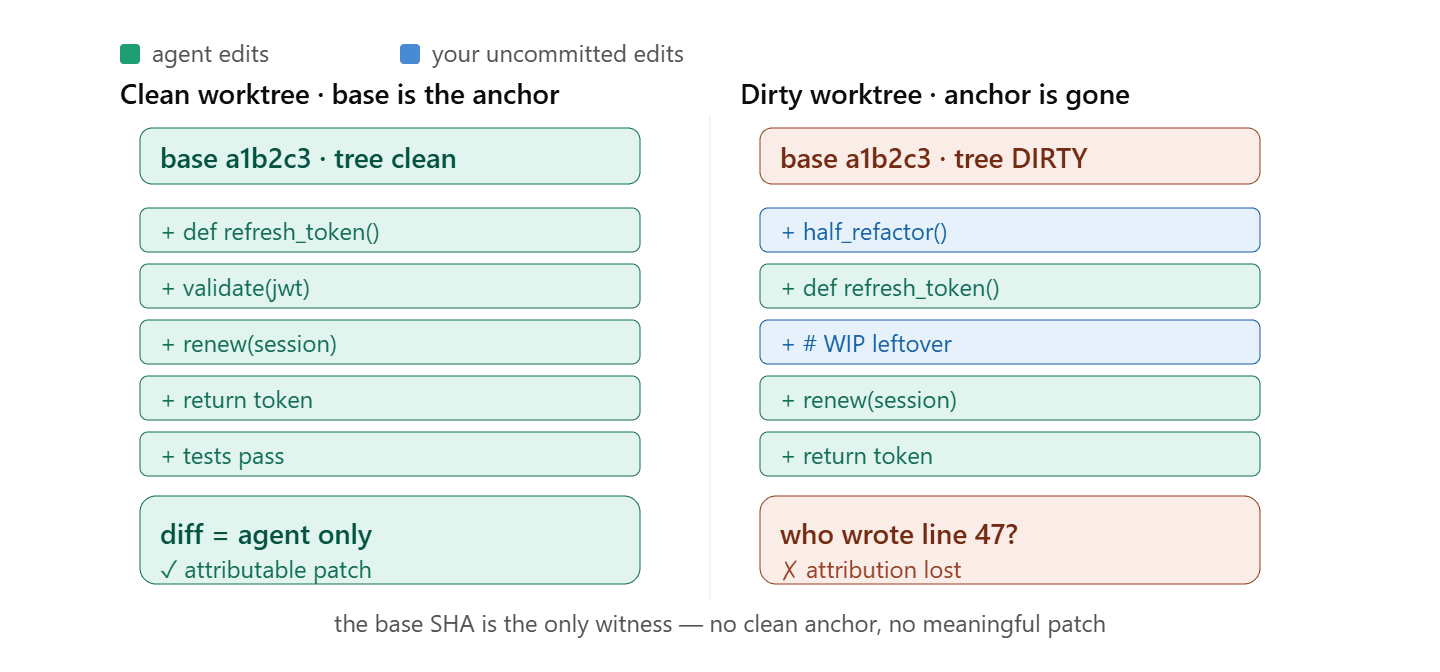
The allow_dirty: false default is important.
If a write-capable agent starts from a dirty working tree, you lose attribution.
Was that diff produced by the agent, by you, or by yesterday’s half-finished refactor?
Puppetmaster refuses dirty trees by default so patch artifacts stay meaningful.
For serious use, run implementation in a dedicated worktree:
Code
bash
git worktree add /tmp/puppetmaster-work -b puppetmaster-work
python -m puppetmaster claude "Implement the approved fix" \
--cwd /tmp/puppetmaster-work \
--permission-mode acceptEdits